
Key takeaways
- As AI automates routine engineering tasks, graduates will be differentiated by their ability to frame problems, exercise judgment and build secure, scalable solutions—not merely by how much code they can produce.
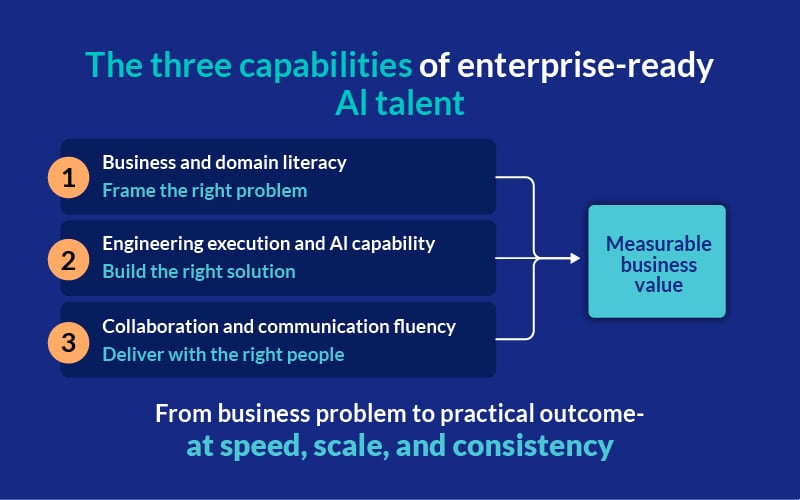
- Enterprise readiness combines three capabilities: business and domain literacy, engineering execution and AI capability, and collaboration and communication fluency.
- Universities should preserve strong academic foundations while augmenting them with real business workflows, industry use cases, guided experimentation and practitioner mentorship.
- Readiness should be measured by what students can build, explain, validate and improve—and the business value they can demonstrate—not by courses, tools or certificates alone.
AI curiosity is high. Real-world problem-solving capability is the real test.
Across my conversations with engineering students and college leaders, one pattern is clear: no one needs to be convinced that AI matters. I see a considerable momentum in this direction to embed AI literacy.
Students are already experimenting with AI tools. Colleges are introducing AI electives, running workshops, adding electives, and strengthening training and placement efforts. Students are experimenting with generative AI tools and completing online certifications. Faculty members are trying to keep pace. Parents are asking increasingly informed questions about future careers. Recruiters are raising expectations.
So, the real question is not whether engineering colleges should teach data and AI. Many institutions are already responding in some form.
The harder question is this: are students truly becoming industry-ready? Are employers happy with the talent produced to solve real-world business problems leveraging data & AI?
Every week, a new exciting announcement happens on the AI horizon. AI curiosity is an important starting point, and it encourages a student to try a tool. But it is not proof of employability. Demonstrable capability is the new employability standard.
Colleges & students are asking what enterprise readiness means.
With over 2 decades of industry experience, I would simplify enterprise readiness in a 3-layer capability, which all modern enterprises require.
- Business and domain literacy – understanding the process, problem, stakeholder, and desired outcome
- Engineering execution and AI capability – selecting, building, validating, and scaling the appropriate solution
- Collaboration and communication fluency – working across functions, communicating decisions, and delivering outcomes
| Imagine two students applying for the same AI internship at a retail enterprise. Both can build a demand-forecasting model. The first student explains the algorithm, the classroom dataset, and the model’s accuracy. The second begins with the business problem: recurring stock-outs. The student identifies the Minimal Viable Data needed to begin, including sales, inventory, product, and promotion data. They compare possible approaches, explain how planners would use the output within the replenishment workflow, consider how performance should be monitored, and define success in business terms. Both students understand technology and can build a model. Only one is enterprise-ready. This is the difference engineering graduates and early talents must appreciate and improve. |
The definition of a good engineer is changing in this AI age.
AI is beginning to perform many tasks that once occupied a significant part of an entry-level engineer’s work—from generating routine code and test cases to creating boilerplate designs, documenting systems, and accelerating debugging.
This creates opportunity where engineers are expected to focus on technology-led value creation. Graduate engineers will increasingly be differentiated not by how much code they can produce manually, but by how well they can frame problems, make sound technological choices, use AI to improve outputs, validate their reliability, and build secure, scalable solutions that work in the real world. The AI-native engineers who shape successful careers in this environment will be more than traditional engineers. They will be thoughtful builders—combining strong fundamentals with systems thinking, business understanding, responsible judgment, creativity, and the ability to collaborate with both people and AI.
Employer expectations are compounding
Employer expectations are also changing. Enterprises are under growing pressure to improve productivity, accelerate innovation, and deliver profitable growth. They consequently expect early-career talent to contribute sooner—not simply by completing assigned technical tasks, but by understanding the problem, using AI responsibly and helping build solutions that work at enterprise scale. Students aspiring to become enterprise-ready AI practitioners should be able to answer:
- Why did you choose this problem, and what outcomes are expected?
- What data was required, and how did you determine the Minimal Viable Data needed to test the use case and generate early evidence of value?
- What alternative approaches did you evaluate?
- What constraints or governance considerations shaped the solution?
- How would you measure success?
- How would the solution fit into an existing business workflow?
- Have you thought of scale and security? Built-in or bolt-in?
Students must be able to understand the business context, identify the smallest relevant and reliable set of data required to begin, evaluate alternative solutions, build and assess a use case, consider how it will fit into an existing workflow, and define how success will be measured.
Enterprise readiness is therefore not simply about knowing more tools. It is about developing the judgment to use technology appropriately to solve business problems and deliver value.
What engineering colleges need to add—not replace
Engineering colleges already provide essential foundations: academic discipline, programming, engineering logic, and faculty guidance and labs for building projects. Few institutes have industry alliances giving some degree of exposure as well.
These foundations should not be replaced. They must be complemented by an application environment in which students can use their academic knowledge to address real-world problems.
Academia teaches:
- Engineering and scientific fundamentals
- Analytical rigor and structured thinking
- Research orientation and learning discipline
- Faculty mentorship
- An environment for sustained intellectual development
Industry contributes:
- Business problem framing and operating realities
- Bite-sized use cases & outcome orientation
- Production workflows and enterprise architecture
- Data management, quality, security, and governance constraints
- Customer and user expectations
- Iterative improvement and incremental outcome-based evaluation
Enterprise readiness develops when these two worlds work together in a cohesive manner.
Students need a structured environment for practice
Enterprise readiness cannot be developed through a single workshop, hackathon, or certification. It comes from repeated, guided hands-on practice.
Students need consistent hands-on exposure to learn how to:
Understand the business challenge and frame the problem → Identify the relevant data → define Bite-Sized use case → Design and build → Test and improve → Connect it to a business workflow → Demonstrate measurable value iterate and improve scale with adequate security and governance
This journey should be supported by an industry-oriented curriculum, real-world use cases, industry practitioner mentorship, collaborative execution, and a safe environment for experimentation.
It is also important that students work on more than isolated technical assignments. They should experience the ambiguity that often accompanies enterprise problems: incomplete requirements, imperfect data, competing priorities, multiple solution options, and the need to communicate with both technical and business stakeholders.
The objective is not only to help students produce an output. It is to help them develop the thinking, judgment, and communication required to explain why that output matters.
From learning activity to demonstrable evidence
College leaders, students, and parents are approached by many ed-tech companies, certification providers and training organisations. They are right to evaluate these opportunities carefully.
The most useful question they can ask is: Does this really make them enterprise AI-ready? Beyond tool-aware.
After completing this programme, what can a student build, explain, and demonstrate that the student could not do before?
The answer should go beyond course completion, attendance, or certification. A strong industry-readiness initiative should create visible evidence of progression:
- Can students frame a business problem more clearly?
- Can they determine what data is relevant?
- Can they develop and compare different approaches?
- Can they build usable solutions instead of isolated models?
- Can they explain governance, security, and responsible AI considerations?
- Can they work in a team, collaborate, and have effective communication to achieve desired results?
- Can they connect technical performance with business value?
- Do they have a portfolio? Can they present their work confidently to an employer or business stakeholder?
This evidence gives students stronger stories for employment interviews. It gives faculty members a practical model they can reinforce. It gives training and placement teams better material for employer conversations. This evidence also enables institutions to evaluate whether learning is translating into meaningful student outcomes.
This is not a replacement for the university curriculum. It is an industry-integrated augmentation layer that helps students convert academic knowledge into enterprise capability.
A structured model for building enterprise-ready capability
Enterprise readiness develops when students repeatedly build, test, explain, and improve solutions grounded in real business contexts. This is the central idea Calibo AI Academy is built around.
- Frame and simplify business problems grounded in real operational contexts
- Decompose the bigger problem into bite-sized use cases, understand the minimum viable data & context to solve it.
- Apply an agile engineering approach, iterative experimentation & drive incremental outcomes leveraging data, AI & relevant technology.
- Create reusable business assets to accelerate business innovation, deliver productivity, operational efficiency and growth.
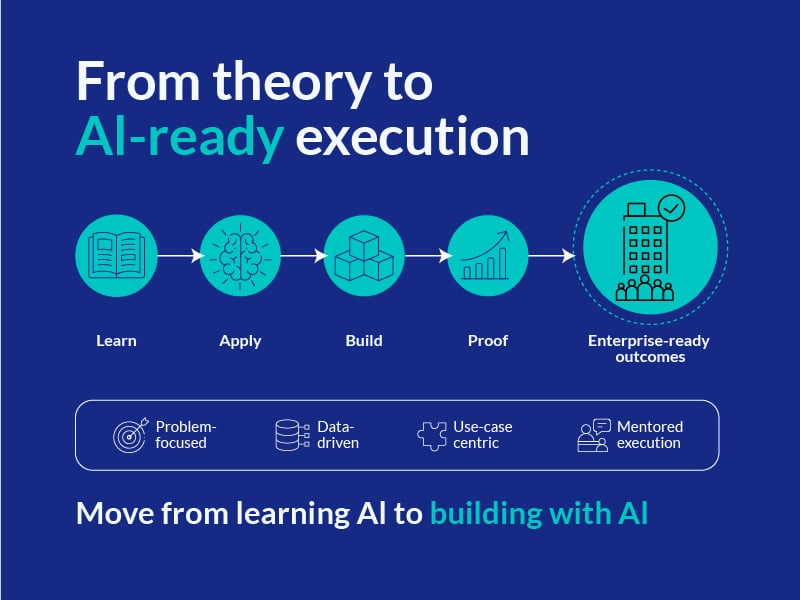
Its industry-anchored curriculum, Calibo Business Innovation Methodology, Calibo Business Innovation Sandbox, real-world use-case development provide a structured environment in which students can practice that journey. Industry masterclasses help students learn the real-world use cases under the guidance and mentorship of expert industry practitioners. This holistic model complements & augments university education by helping students apply academic foundations to business workflows, data constraints, cross-functional decisions, and outcome-oriented execution.
Institutional leadership will set the next standard
College leaders should not measure data and AI readiness only by the number of courses, workshops, tools, or certificates available to students. They should measure it by what students can build, explain, evaluate, and improve.
The colleges that lead the next decade will not necessarily be those that teach the most AI. They will be the ones that consistently help students turn academic knowledge into responsible, business-relevant data and AI solutions—and give them the judgment and evidence to explain that work.
That is the standard future-ready engineering education should aspire to.
Explore how Calibo AI Academy can complement your institution’s curriculum with structured, industry-anchored AI practice.
FAQs
Why is AI curiosity not enough for engineering students?
AI curiosity helps students explore tools, but employability requires more than exploration. Students need structured practice, business context, responsible data and AI application, mentorship, and real-world use-case experience. So, students must develop capability along with curiosity.
What should engineering colleges look for in an AI readiness program?
Engineering colleges should look beyond tool exposure and certificates. A strong program should help students frame business problems, work with data, identify Minimal Viable Data, build bite-sized use cases, collaborate, and demonstrate practical execution.
How is the Calibo AI Academy different from a regular AI course?
The Calibo AI Academy combines the Calibo Business Innovation Methodology, the Calibo Business Innovation Sandbox, industry mentorship, and real-world use-case building. The focus is not only on learning tools, but also on building practical data and AI capabilities.
Proposed related articles
Trending articles

Data orchestration: why modern enterprises need a data orchestration platform
Data is pouring in from myriad sources—cloud applications, IoT sensors, customer interactions, legacy databases—yet without proper coordination, much of it remains untapped potential. This is where data orchestration comes in.

How Enterprise Architects can get more support for technology led innovation
Enterprise Architects are increasingly vital as guides for technology-led innovation, but they often struggle with obstacles like siloed teams, misaligned priorities, outdated governance, and unclear strategic value. The blog outlines six core challenges—stakeholder engagement, tool selection, IT-business integration, security compliance, operational balance, and sustaining innovation—and offers a proactive roadmap: embrace a “fail fast, learn fast” mindset; align product roadmaps with enterprise architecture; build shared, modular platforms; and adopt agile governance supported by orchestration tooling.

Why combine an Internal Developer Portal and a Data Fabric Studio?
Discover how to combine Internal Developer Portal and Data Fabric for enhanced efficiency in software development and data engineering.

The differences between data mesh vs data fabric
Explore the differences of data mesh data fabric and discover how these concepts shape the evolving tech landscape.