
Key takeaways
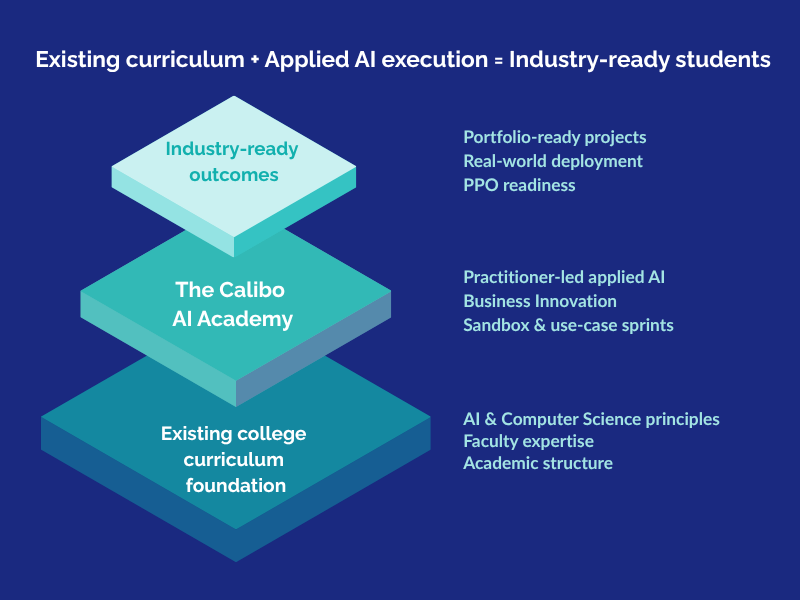
- The Calibo AI Academy is an augmentation model that works with existing AI, CS, AI/DS, and data science curriculums instead of replacing them.
- The no curriculum reinvention cost means colleges do not need a curriculum overhaul, academic restructuring, or faculty replacement to explore a partnership.
- Our AI Academy adds practical industry exposure through the Calibo Business Innovation Sandbox, Business Innovation Methodology, real-world use-case building, practitioner-led learning, mentorship, and faculty enablement.
When college leaders first hear about an external AI training program, one concern often comes up quickly: “We already have an AI curriculum.”
It is a fair response. Many engineering colleges already run AI, AI/DS, CS, and data science branches. Their programs are structured, faculty-led, and aligned with approved academic curriculum requirements. Students are choosing AI-related streams in large numbers, and institutions have already invested in faculty, labs, schedules, and curriculum planning.
That is why the Calibo AI Academy is designed as an augmentation model.
It is not to disrupt academic autonomy or ask institutions to rebuild from scratch. Our AI Academy sits alongside the existing AI curriculum for engineering colleges and adds the layer many institutions increasingly need: practical application, industry exposure, real-world use-case building, and a structured pathway from AI learning to AI employability.
In simple terms: your curriculum builds knowledge. The AI Academy activates it.
“We already have an AI curriculum” is the starting point
In conversations with principals, deans, directors, and training and placement leaders, the initial reaction is often curiosity mixed with comparison. Colleges want to understand how AI Academy is different from their approved academic curriculum, internal labs, faculty-led initiatives, certifications, or other programs in the market.
That comparison is natural and is also the right place to begin.
The real question is usually not, “Do we need AI?” Most colleges already know they do. The deeper questions are more practical:
- Will this improve student readiness?
- Can it fit within existing academic schedules?
- Can it create value without adding operational complexity?
These are not signs of resistance. They are signs that college leaders are evaluating whether an AI Academy college partnership can create real value without adding unnecessary complexity.
What does no reinvention cost mean
The no reinvention cost means colleges do not need to reinvent their academic systems to partner with the Calibo AI Academy.
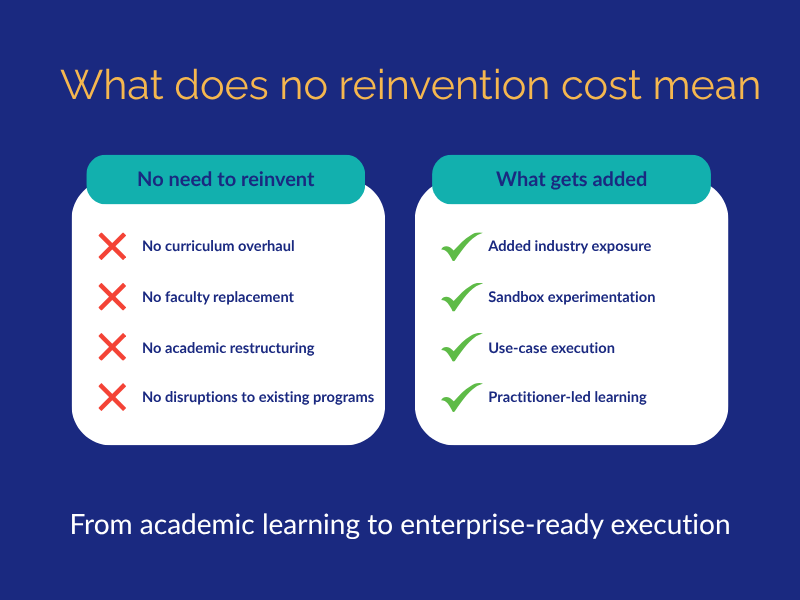
AI Academy is designed to reduce that friction. The model can be aligned with college schedules through practitioner-led sessions, hands-on experimentation, guided labs, industry masterclasses, use-case sprints, and portfolio-building activities.
The college continues to deliver the academic foundation. AI Academy adds the applied, industry-oriented layer.
How the AI Academy sits alongside your curriculum
The Calibo AI Academy brings together four connected components: an industry-anchored curriculum, the Business Innovation Sandbox, the Calibo Business Innovation Methodology, and real-world use-case building supported by industry practitioners.
The curriculum is practitioner-led, project-based, and production-ready. At an overview level, students move through an 8-month learning journey that builds from foundational AI fluency to applied systems thinking, deployment readiness, and portfolio-grade outcomes. The program introduces students to applied AI workflows, GenAI systems, modern AI tooling, governance, and real-world solution development.
But the difference is not only what students learn. It is how they apply it.
The Business Innovation Sandbox gives learners a controlled environment to experiment with AI models, LLMs, agentic systems, data workflows, and solution assets. Students can build, test, refine, and understand how AI solutions behave in practical contexts.
The Calibo Business Innovation Methodology gives students a structured way to solve problems. It teaches them to frame business challenges, map value streams, define outcomes, and break complex problems into bite-sized, executable use cases.
Use-case-driven learning then connects the experience to real industries. Students may work through scenarios such as:
- Smart inventory replenishment advisors
- Insurance claim pre-assessment agents
- Predictive maintenance systems
- Contract obligation trackers
- Threat triage copilots
The goal is to help students understand how AI is applied within real business workflows and decision environments.
The MoU model: Partnership without replacement
The Calibo AI Academy is designed as a partnership model, not a replacement model. Through an MoU-based engagement, colleges can explore a structured collaboration that supports student readiness while respecting the institution’s existing academic frameworks.
For leadership teams, this makes the model easier to evaluate. It can be aligned with batches, departments, schedules, and institutional priorities. It gives colleges a way to bring industry exposure into the student journey without asking academic teams to start over.
This model is a curriculum plus the AI Academy.
The college provides the foundation. AI Academy adds application, Business Innovation Sandbox, Business Innovation Methodology, practitioner guidance, use-case execution, mentorship, and employability orientation.
Faculty enablement builds institutional capability
A strong partnership should not bypass faculty. It should strengthen them.
That is why faculty enablement is an important part of the AI Academy model. The framework is intended to help faculty understand the curriculum, sandbox, methodology, use cases, and delivery approach. The goal is alignment and long-term institutional capability, not dependency.
When faculty understand how the program works, they can guide students more effectively, connect Academy learning with classroom learning, and help the institution build a stronger AI-ready culture over time.
Faculty enablement should be seen as empowerment, not replacement.
From teaching AI to producing AI-ready practitioners
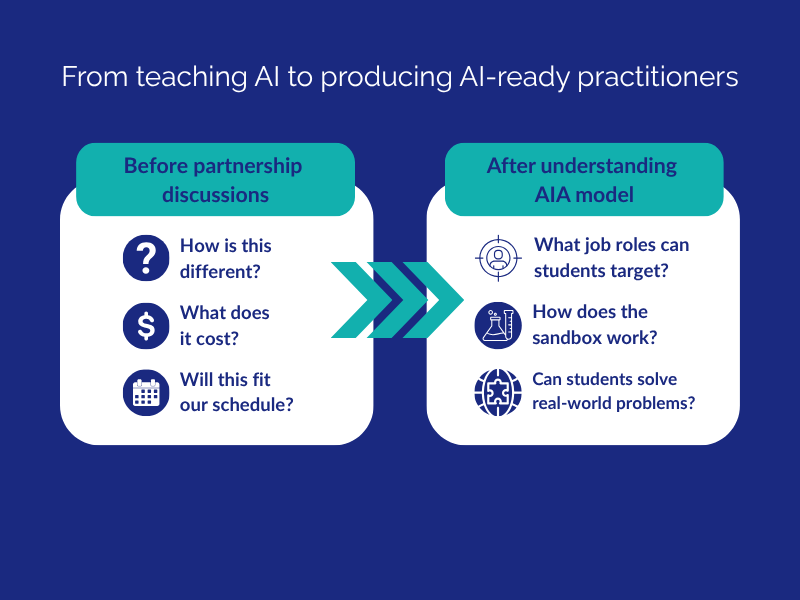
As the conversation deepens, the focus usually shifts to outcomes: student readiness, placement pathways, job roles, practical exposure, PPO, industry credibility, and real-world project work.
That shift matters.
Colleges do not need more AI content for the sake of content. They need stronger outcomes from the AI education they are already committed to delivering.
The AI Academy helps strengthen student readiness through industry exposure, a governed Business Innovation Sandbox, practitioner-led learning, Business Innovation Methodology-based problem solving, mentorship, and use-case sprints.
You are already teaching AI. Now it is time to help students use it where it matters.
See how our Calibo AI Academy helps colleges build future-ready AI practitioners.
FAQs
How will the Calibo AI Academy partnership fit without disrupting our approved academic curriculum?
The AI Academy works as an augmentation layer. Your college continues its curriculum; Calibo adds practitioner-led sessions, sandbox, Business Innovation Methodology, use-case sprints, and mentoring alongside it.
What factors should colleges consider when evaluating an AI Academy partnership?
Colleges should evaluate how well the program aligns with their academic structure, student learning goals, industry relevance, faculty collaboration model, and hands-on learning approach. It is also important to assess whether the program helps students build practical, real-world problem-solving experience through industry-anchored use cases, mentorship, and applied learning environments.
What does “no reinvention costs” mean?
It means colleges do not need to reinvent their academic structure to partner with the Calibo AI Academy. The model does not require a curriculum overhaul, department restructuring, or faculty replacement. It doesn’t refer to program pricing.
Trending articles

Data orchestration: why modern enterprises need a data orchestration platform
Data is pouring in from myriad sources—cloud applications, IoT sensors, customer interactions, legacy databases—yet without proper coordination, much of it remains untapped potential. This is where data orchestration comes in.

How Enterprise Architects can get more support for technology led innovation
Enterprise Architects are increasingly vital as guides for technology-led innovation, but they often struggle with obstacles like siloed teams, misaligned priorities, outdated governance, and unclear strategic value. The blog outlines six core challenges—stakeholder engagement, tool selection, IT-business integration, security compliance, operational balance, and sustaining innovation—and offers a proactive roadmap: embrace a “fail fast, learn fast” mindset; align product roadmaps with enterprise architecture; build shared, modular platforms; and adopt agile governance supported by orchestration tooling.

Why combine an Internal Developer Portal and a Data Fabric Studio?
Discover how to combine Internal Developer Portal and Data Fabric for enhanced efficiency in software development and data engineering.

The differences between data mesh vs data fabric
Explore the differences of data mesh data fabric and discover how these concepts shape the evolving tech landscape.