
Key takeaways
- Employability now depends on degree + evidence + adaptability, not data and AI exposure alone.
- Students need a practical skill stack that includes problem framing, data literacy, AI fluency, business awareness, communication, responsible use, and portfolio proof.
- Calibo AI Academy helps students move from learning to visible capability through industry-integrated curriculum, the Calibo Business Innovation Methodology, the Calibo Business Innovation Sandbox, mentorship, and real-world use-case building.
Students entering the job market must become enterprise-ready for workplaces where data and AI are no longer confined to specialist teams. In these environments, data and AI increasingly shape research, writing, analysis, customer service, product development, operations, and decision support.
The practical question is: what should a graduate learn now so that data and AI become an advantage, not a gap?
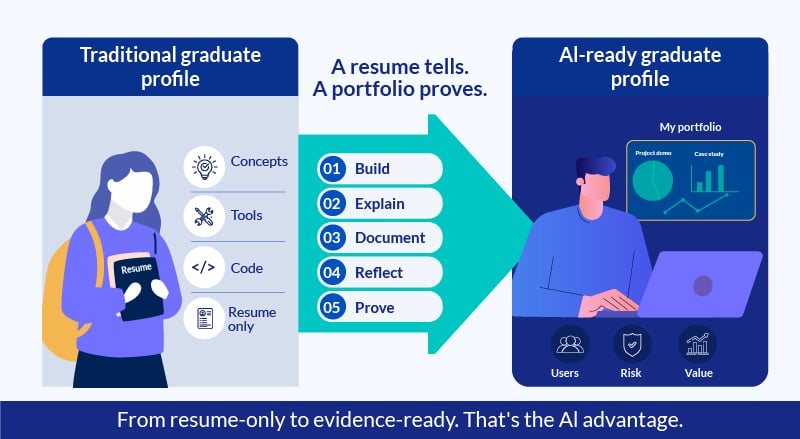
Degrees still matter. But degrees alone do not show whether a student can frame a problem, work with data, use data and AI responsibly, build something useful, verify outputs, and explain value clearly. The stronger employability signal is visible evidence of capability.
The difference is not whether a student has used AI. It is whether they can use AI to solve a problem, explain their thinking, and show proof of what they built.
Employability is changing, not disappearing
The conversation around AI and jobs often becomes either too fearful or too vague. A more useful way to look at it is this: work is being reshaped, and the skills employers value are changing with it.
According to World Economic Forum data showing that 86% of employers expect AI and information processing to transform their business by 2030. It also notes that 39% of workers’ existing skill sets are expected to change or become outdated by 2030, and 63% of employers identify skill gaps as a major barrier to transformation.
For students, this does not mean every graduate must become an AI engineer. It means every graduate needs a practical data and AI edge: the ability to work with new tools while retaining human strengths such as analytical thinking, creativity, communication, judgment, and context.
The job market is not rewarding degrees alone. It is rewarding degree + evidence + adaptability. Degrees open the door, while evidence and adaptability move students forward.
The new divide: AI exposure vs. data and AI employability
A student may have AI exposure and still not be employable in a data- and AI-driven role. Using tools to summarize notes, generate content, write basic code, or complete assignments can be useful, but exposure is only the starting point.
Employability comes from applying data and AI in context.
A student with basic exposure may say, “I used an AI tool.” A more employable student can say, “I understood this problem, used this data, chose this approach, tested the output, documented the limitations, and can explain the value of the solution.”
That difference matters. Employers are not only looking for tool users. They need graduates who can think, build, verify, communicate, and adapt inside data and AI-enabled workflows.
What students must learn to stay employable
1. Frame problems before choosing tools
The first skill is clear thinking.
Before using any tool, students should learn to ask:
- What problem am I solving?
- Who has this problem?
- What data or context is needed?
- What does a useful outcome look like?
- What risks or constraints should be considered?
This prevents tool-chasing. It also helps students connect technical work to real outcomes, which is what employers and business teams care about.
2. Build data and AI fluency
Students do not need to master every model or framework at once. They do need enough fluency to understand how data and AI systems are used in real work.
That includes prompting, verification, data literacy, spreadsheets, SQL or Python where relevant, and an understanding of how models, workflows, and outputs fit together. For engineering students, this can extend into machine learning, GenAI, RAG, agents, APIs, and deployment concepts.
AI careers are not only for engineers. data and AI fluency is becoming valuable across analytics, product, operations, marketing, finance, consulting, HR, and core technology roles.
3. Create small, working projects
Students need visible proof of what they can do.
A small, well-explained project is more useful than a large but unclear one. Students can begin with a bounded proof of concept: an FAQ assistant, a study helper, a research workflow, a simple dashboard, a classification task, or a document-processing workflow.
The goal is not perfection. The goal is to show that the student can define a problem, build a working artifact, make decisions, test results, document limitations, and improve the work after feedback.
4. Use data and AI responsibly
Responsible data and AI use is now part of career readiness.
Students should learn to verify outputs, check sources, understand privacy concerns, identify bias, document limitations, and know when human judgment is required.
Prompting is not the skill; judgment is.
Workplaces do not need graduates who blindly trust confident outputs. They need people who can use data and AI with accuracy, accountability, and context.
5. Explain value clearly
The strongest student work is not only functional. It is explainable.
Students should practice communicating their work in a simple employer-facing narrative: the problem they addressed, the data and AI approach they used, the workflow decisions they made, the limitations they considered, and the value the solution is designed to support.
This helps in internship conversations, interviews, portfolio reviews, and project presentations. It shows what the student built and how they think.
A 90-day data and AI employability plan
Students do not need to wait until final year to start building evidence. Calibo AI Academy suggests a practical 90-day starter sequence that moves students from learning to visible proof.
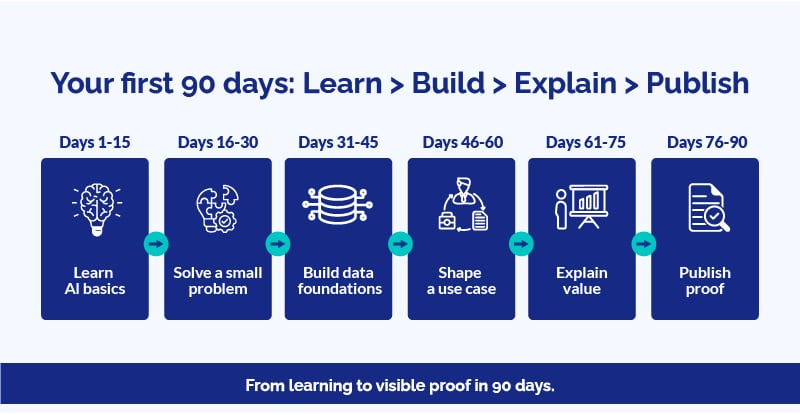
Days 1–15: Learn AI basics
Start with prompt structure, AI limitations, and verification habits. The goal is to learn how to use AI carefully, check outputs, and understand where human judgment is needed.
Days 16–30: Solve a small workflow problem
Choose one simple problem from a familiar area, such as studying, research, reporting, planning, or communication. Use AI to improve that workflow, and document what problem you solved.
Days 31–45: Build data foundations
Add basic data skills through spreadsheets, SQL, or Python. Students should learn how to organize information, ask questions, and use data as the foundation for better decisions.
Days 46–60: Shape a use case
Turn the small project into a clearer use case by defining the user, pain point, outcome, and risks. This helps students move from “I used an AI tool” to “I used AI to address this specific problem.
Days 61–75: Explain value
Create a short demo and explain the business relevance. Students should be able to describe what they built, why it matters, what choices they made, and what they would improve.
Days 76–90: Publish proof
Turn the work into a GitHub artifact, slide deck, case note, or portfolio page. This gives students something concrete to show during an internship or interview.
This sequence gives students a realistic way to start building capability alongside college learning.
What parents should look for
For parents, the employability conversation should move beyond and ask a better set of questions like:
- What will my child build?
- How will progress be visible?
- How will they learn to check data and AI outputs?
- Will they develop communication and interview readiness?
- What portfolio evidence will they have?
Parents must look for structured progression, mentorship and feedback, real projects and artifacts, communication readiness, and a credible portfolio narrative.
These are stronger trust signals than hype or tool exposure alone.
Where Calibo AI Academy fits in
The Calibo AI Academy is designed around the shift from AI exposure to data and AI employability.
The AI Academy combines industry-anchored curriculum, the Calibo Business Innovation Methodology, the Calibo Business Innovation Sandbox, mentorship, and real-world use-case building. This helps students move beyond theory and tool practice toward business-centered execution.
The Business Innovation Methodology helps students spot business problems, frame use cases, prepare data and context, choose the right workflow, build and critique, and present business value. The Business Innovation Sandbox gives students a structured environment to experiment, test, and refine their work through practical use cases.
This matters because students need more than content consumption. They need a learning journey that builds confidence, communication, and evidence. The Calibo AI Academy describes an applied AI journey as one that includes technical foundations, sandbox builds, feedback, iteration, business awareness, communication, and proof through portfolios, capstones, GitHub artifacts, and presentation confidence.
In a data and AI-driven job market, the students who stay employable will not be the ones who simply know that AI exists. They will be the ones who learn continuously, build visibly, explain value clearly, and use data and AI responsibly in the human-led systems that organizations are creating.
Explore how Calibo AI Academy helps students move from AI exposure to visible capability.
FAQs
Do students need to become AI engineers to stay employable?
More than becoming a specialist AI engineer, every student need a practical data and AI edge. They need to have a clear understanding of how to work with AI-enabled tools, frame problems, use data responsibly, verify outputs, and explain the value of their work.
What does “evidence of capability” mean for students?
Evidence of capability means students can show a working prototype, dashboard, automation, assistant, analysis, README, demo, reflection, or short business case instead of only certificates. The goal is to show what problem the student addressed, what approach they used, how they tested it, and what they learned.
How can non-technical students begin if they do not know data and AI tools yet?
Students can begin with a small, bounded problem. They can choose a domain, identify a pain point, build a simple proof of concept, document their decisions, and improve the work over time. The first goal is not mastery of every tool; it is disciplined practice and visible progress.
Trending articles

Data orchestration: why modern enterprises need a data orchestration platform
Data is pouring in from myriad sources—cloud applications, IoT sensors, customer interactions, legacy databases—yet without proper coordination, much of it remains untapped potential. This is where data orchestration comes in.

How Enterprise Architects can get more support for technology led innovation
Enterprise Architects are increasingly vital as guides for technology-led innovation, but they often struggle with obstacles like siloed teams, misaligned priorities, outdated governance, and unclear strategic value. The blog outlines six core challenges—stakeholder engagement, tool selection, IT-business integration, security compliance, operational balance, and sustaining innovation—and offers a proactive roadmap: embrace a “fail fast, learn fast” mindset; align product roadmaps with enterprise architecture; build shared, modular platforms; and adopt agile governance supported by orchestration tooling.

Why combine an Internal Developer Portal and a Data Fabric Studio?
Discover how to combine Internal Developer Portal and Data Fabric for enhanced efficiency in software development and data engineering.

The differences between data mesh vs data fabric
Explore the differences of data mesh data fabric and discover how these concepts shape the evolving tech landscape.