
Key takeaways
- The 75% employer-demand signal is not just about hiring more AI specialists. It reflects a broader shift toward graduates who can apply data and AI in practical, business-facing context.
- Industry-anchored learning, business use cases, and governed experimentation environments are becoming important for student readiness.
- Colleges that strengthen applied AI learning today are better positioned to improve long-term placement competitiveness and industry alignment.
The question is no longer whether AI will affect graduate employability. It already is.
For engineering colleges, the finding that 75% of Indian employers want AI talent points to a clear shift in hiring expectations. Employers are not only looking for graduates who understand AI concepts. They increasingly want talent that can apply data and AI to real business problems, work with practical workflows, and contribute in enterprise environments.
That shift matters because India’s employability challenge is already significant. According to the India Skills Report 2026, India’s overall employability rate stands at 56.35%. The report also points to a clear employer preference for practical, applied skills over theoretical knowledge alone.
For college leadership teams, the implication is clear: rising demand for AI talent is not only about producing more AI-aware students. It is about preparing graduates who can become enterprise-ready data and AI practitioners.
The employability challenge is no longer about degrees alone. It is also about practical execution, business-facing problem solving, and readiness for real enterprise environments.
AI is changing the expectations for entry-level talent
For years, enterprises accepted that fresh graduates would require significant retraining after hiring. Many organizations invested 6–12 months helping early-career talent adapt to real business environments, working with data, integrating tools, designing process steps, validating outputs, and presenting outcomes.
That model is changing rapidly.
As AI automates portions of traditional entry-level technical work, employers are placing greater emphasis on graduates who can contribute earlier, adapt faster, and work within real operational environments.
The World Economic Forum’s Future of Jobs research and industry workforce reports point toward the same direction: AI is not simply creating new technical roles. It is reshaping how work itself is performed across industries.
This affects hiring expectations.
Increasingly, employers are not only asking whether graduates understand AI concepts. They are asking whether graduates can apply AI in business workflows, collaborate across functions, and contribute to measurable outcomes.
For engineering colleges, this creates a new employability reality.
The employability gap is becoming more practical
Most engineering colleges today already offer AI, AI/DS, computer science, or data science programs. Students are learning programming languages, algorithms, machine learning concepts, and AI fundamentals.
But employers are increasingly evaluating something beyond theoretical familiarity.
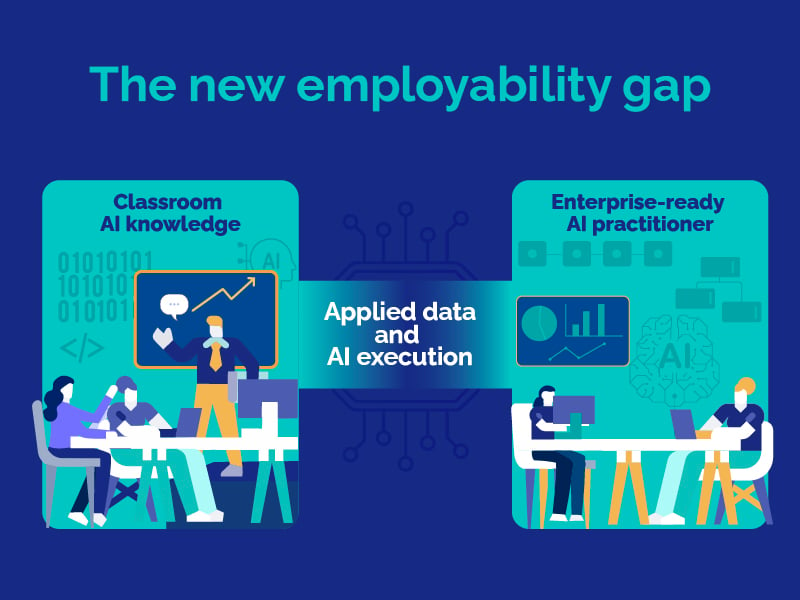
The challenge is not basic AI awareness; it is applied AI execution capability.
Many students know prompting tools or have experimented with AI platforms. But far fewer have hands-on experience with:
- Solving real business problems
- Working with practical workflows and datasets
- Understanding governance and security considerations
- Building end-to-end AI solutions
- Translating business requirements to executable use cases
- Collaborating within cross-functional environments
This gap matters because enterprises are increasingly looking for graduates who can operate in enterprise delivery environments, not only classroom environments.
The market is moving from “AI knowledge” toward “AI application.”
Why applied skills are becoming a placement differentiator
According to industry workforce studies, employers increasingly prioritize applied capability, adaptability, and business-facing problem solving.
This shift is especially important for training and placement leaders.
Traditional placement readiness indicators — academic scores, certifications, or isolated project work — are no longer enough on their own in highly competitive hiring environments.
Employers want graduates who can demonstrate:
- Practical AI workflow understanding
- Real-world problem-solving ability
- Familiarity with enterprise tools and environments
- Cross-functional collaboration skills
- Outcome-oriented execution mindset
- Exposure to modern AI systems and workflows
This is where a major gap often appears between classroom learning and enterprise expectations.
Students may understand AI concepts academically but still struggle to connect those concepts to operational business use cases. This directly affects placement competitiveness.
The rise of the enterprise-ready AI practitioner
A new talent profile is emerging across industries: the enterprise-ready AI practitioner.
They are learners who can connect business understanding, data workflows, AI systems, and execution thinking into practical problem solving.
An enterprise-ready AI practitioner understands how to:
- Break large problems into manageable use cases
- Apply AI within business workflows
- Work with data responsibly
- Understand operational constraints
- Build and refine AI-enabled solutions iteratively
- Focus on measurable outcomes rather than experimentation alone
This is increasingly the direction enterprises, GCCs, and technology teams are moving toward.
For colleges, the implication is important: employability is becoming more connected to applied execution capability than theoretical exposure alone.
How colleges can respond without rebuilding their curriculum
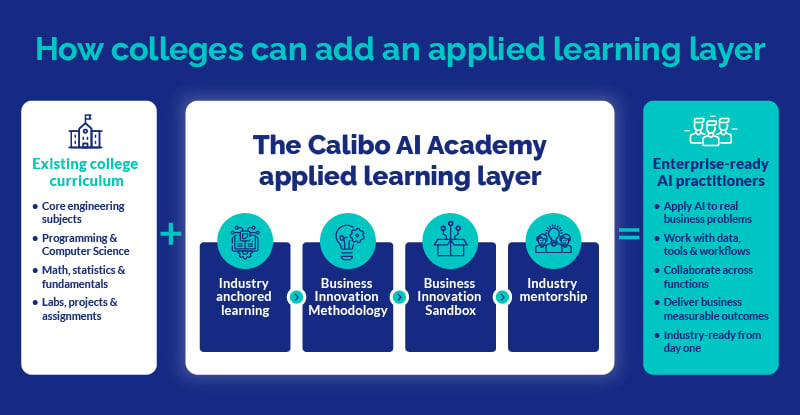
This shift does not require colleges to replace their existing academic foundations. It requires a stronger bridge between what students learn in classrooms and what employers expect in real delivery environments.
Increasingly, institutions are exploring models that complement traditional learning with:
- Practitioner-led exposure
- Real-world use-case building
- Hands-on experimentation environments
- Business-oriented problem framing
- Mentorship from industry professionals
- Portfolio-driven learning experiences
This is precisely the gap initiatives like the Calibo AI Academy are designed to address.
Our AI Academy combines industry-anchored learning with the Calibo Business Innovation Methodology and the Business Innovation Sandbox to help students move beyond theory into practical execution.
Instead of focusing only on isolated AI concepts, students work through business use cases, applied workflows, and outcome-oriented problem solving in a governed experimentation environment.
The goal is preparing future-ready AI practitioners who can contribute within real enterprise environments.
Why this matters for engineering colleges now
For principals, heads of department, and training and placement teams, this shift is becoming increasingly strategic.
Graduate employability affects:
- Placement outcomes
- Institutional reputation
- Industry partnerships
- Student enrollment competitiveness
- Long-term alignment with workforce demand
The colleges that adapt early will likely be better positioned to meet changing employer expectations. Because the next generation of graduates will not compete only on degrees or certifications. They will compete on their ability to design, build, and operationalize AI-enabled solutions that create measurable business value.
Explore how the Calibo AI Academy complements engineering and AI programs with industry-anchored, applied learning.
FAQs
Why are applied AI skills becoming more important for graduate employability?
Employers want graduates who can apply AI within practical business workflows, solve real-world problems, and contribute to operational outcomes instead of relying only on theoretical knowledge.
What is the difference between learning AI and becoming enterprise-ready?
Learning AI often focuses on concepts and tools. Becoming enterprise-ready involves applying AI within business contexts, working with workflows and data, and solving outcome-oriented use cases.
What makes industry-anchored AI learning different?
Industry-anchored learning connects classroom concepts to practical business environments through use-case execution, mentorship, applied workflows, and hands-on experimentation.
Trending articles

Data orchestration: why modern enterprises need a data orchestration platform
Data is pouring in from myriad sources—cloud applications, IoT sensors, customer interactions, legacy databases—yet without proper coordination, much of it remains untapped potential. This is where data orchestration comes in.

How Enterprise Architects can get more support for technology led innovation
Enterprise Architects are increasingly vital as guides for technology-led innovation, but they often struggle with obstacles like siloed teams, misaligned priorities, outdated governance, and unclear strategic value. The blog outlines six core challenges—stakeholder engagement, tool selection, IT-business integration, security compliance, operational balance, and sustaining innovation—and offers a proactive roadmap: embrace a “fail fast, learn fast” mindset; align product roadmaps with enterprise architecture; build shared, modular platforms; and adopt agile governance supported by orchestration tooling.

Why combine an Internal Developer Portal and a Data Fabric Studio?
Discover how to combine Internal Developer Portal and Data Fabric for enhanced efficiency in software development and data engineering.

The differences between data mesh vs data fabric
Explore the differences of data mesh data fabric and discover how these concepts shape the evolving tech landscape.