

How Enterprise Architects can get more support for technology led innovation
Enterprise Architects are increasingly vital as guides for technology-led innovation, but they often struggle with obstacles like siloed teams, misaligned priorities, outdated governance, and unclear strategic value. The blog outlines six core challenges—stakeholder engagement, tool selection, IT-business integration, security compliance, operational balance, and sustaining innovation—and offers a proactive roadmap: embrace a “fail fast, learn fast” mindset; align product roadmaps with enterprise architecture; build shared, modular platforms; and adopt agile governance supported by orchestration tooling.
Team Calibo, June 18, 2025
Read more

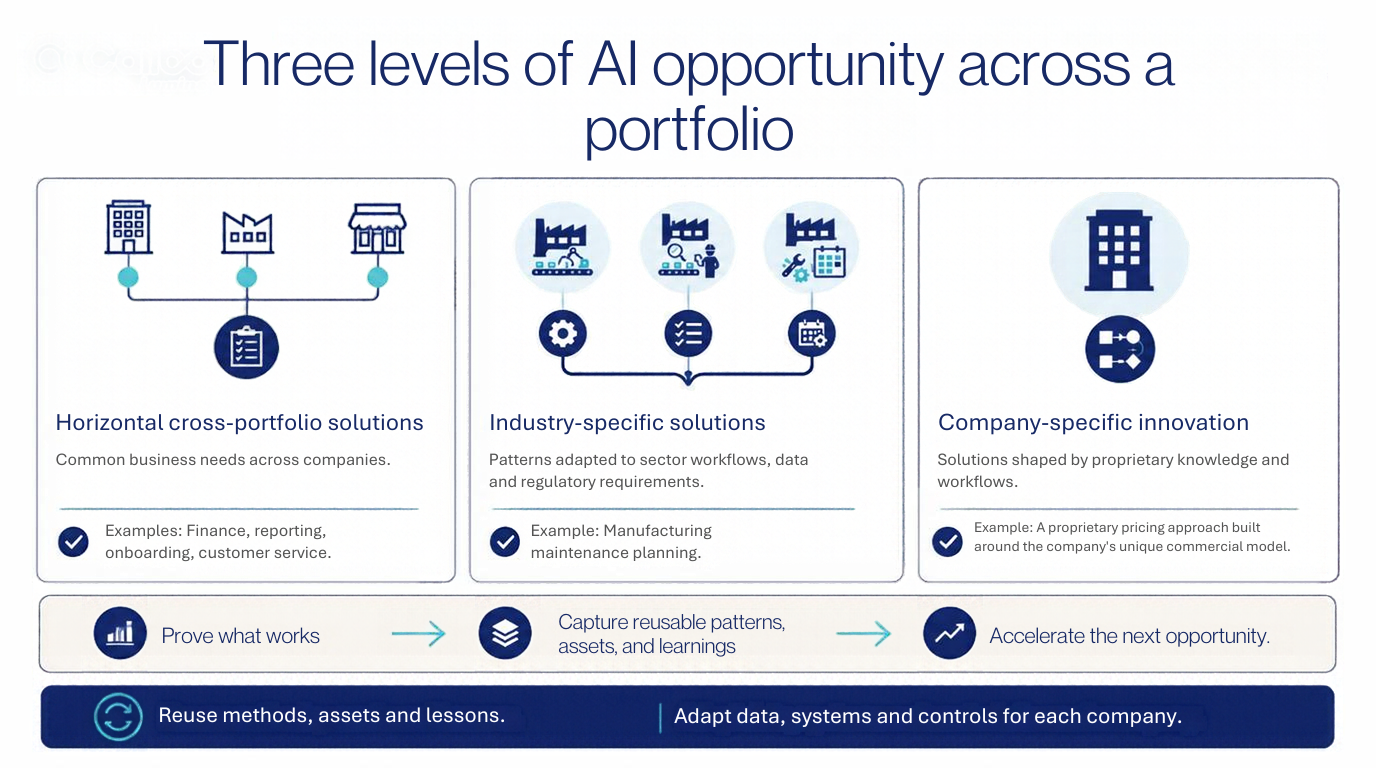
From AI pilots to portfolio value
A proven AI use case can create a starting point for the next portfolio company. By capturing reusable patterns, assets, and lessons, private equity operating teams can help teams avoid repeated discovery and advance the next business opportunity. An AI initiative reaches production at one portfolio company. Its business owner can show an improvement in…

AI doesn’t have a technology problem. It has an operating model problem.
An operating model for business innovation connects AI investment to governed execution, adoption, and measurable business outcomes. When business units fund their own AI initiatives, a CIO can inherit responsibility for security and integration without a shared view of what those initiatives should deliver. The business has approved investment, and technology teams are managing the…

Why enterprise AI pilots fail to deliver business impact
A convincing AI demonstration does not guarantee business value. Explore six gaps that keep enterprise AI pilots from delivering sustained impact, with four practical questions to assess ownership, data, decision authority and readiness for live use.

AI: Hype and Reality
Enterprises are investing heavily in AI, but investment alone does not create business outcomes. This article explores how business ownership, governed AI-ready data, a consistent innovation methodology and reusable business assets can help turn AI experimentation into growth, operational efficiency and reduced technical debt.
The AI execution gap in private equity
Private equity firms increasingly understand where AI can create value. The emerging advantage is execution: selecting the right opportunities and repeatedly turning them into measurable growth and efficiency across portfolio companies.

Plan the last mile early: from POC to production at scale – Part 3
A successful POC is only the beginning. This blog explains how to plan the last mile early, with practical guidance on modular architecture, MLOps, governance, scaling, and the tools and platforms that help move AI and data initiatives into production faster.
