
The barriers to innovation often emerge between an agreed business opportunity and the work required to put it into practice.

Key takeaways
- Give each idea an accountable business owner, a focused use case and decisions that connect experimentation to live use.
- Bring data, security, architecture and operational requirements into the work early so teams can move through enterprise controls with clarity.
- Preserve validated assets and lessons so the next initiative starts further ahead, with reuse and expansion guided by evidence.
A promising idea can lose momentum long before anyone decides to stop it. The business problem is real. Executive interest is there. People begin working. Yet responsibility for turning the idea into a usable outcome becomes divided across teams, decisions, and budgets.
Consider a fictional equipment manufacturer whose service teams spend too much time finding the information needed to answer customer requests. A leadership meeting approves an initial budget to explore a better approach. An AI assistant looks promising. Six months later, a demonstration works, but the service queue has barely changed. This is an illustrative scenario, not a Calibo customer result.
What happened between executive enthusiasm and implementation? The idea encountered legitimate enterprise requirements without a shared way to work through them. As the initiative grew, the original outcome became harder to see.
Follow the idea through the organization
The service leader wanted teams to resolve requests sooner while maintaining the checks required by customer contracts. Watch how that focused opportunity changes as it moves through the business.
The opportunity becomes a technology discussion
The first conversations concern which AI model to use, whether to build or buy, and which departments could benefit. The service use case expands into an enterprise knowledge assistant. That may be a worthwhile ambition, but the team has not agreed what the first release must improve.
The data raises questions nobody has assigned
Service histories sit in one system, contract terms in another, and technical guidance in documents maintained by different teams. Which version should the assistant use? Who can resolve conflicting definitions? Who may access each customer’s information? The team needs decisions about meaning and permitted use as well as access.
Enterprise requirements change the design
Security asks how access will be enforced. Legal asks whether an answer could imply a contractual commitment. Architecture asks how the assistant will connect to the service system. These are reasonable questions. Answering them after a design has been chosen can mean rebuilding parts of it.
Ownership becomes divided
The innovation team funds the experiment. Service owns the customer problem. IT would operate the eventual solution. Each has a stake, but nobody has agreed who can narrow the scope, fund the next stage or change the service workflow. The project keeps moving between meetings without resolving the next decision.
A demonstration leaves the hardest handoff open
The assistant can retrieve an answer from selected documents. To use it in daily operations, the organization still needs access controls, integration, support and a clear process for checking uncertain answers. The service team also needs time to learn and adopt the workflow. Implementation starts to look like a second project.
The idea has accumulated work without establishing a complete route to the outcome that justified it.
Where do good ideas lose momentum?
The barriers to innovation emerge when necessary work lacks clear ownership, sequencing, or decision criteria. Several patterns in this journey deserve attention.
Alignment happens without decision rights. Involving business, IT, data, and control teams is essential. Progress slows when consultation does not lead to an authorized decision. Every meeting needs a purpose, a responsible decision-maker, and evidence sufficient for the next step.
Technology selection overtakes the outcome. The manufacturer can compare models for months without deciding whether its first priority is finding contract terms or recommending a response. Those tasks have different data needs, consequences of error, and success measures.
Important constraints appear after commitment. A team can evaluate an idea in a setting that omits the conditions of actual use. Later discoveries about permissions, integration, or human review then change the design and its economics.
Preparation is repeated. Teams recreate environments, resolve the same access questions, and rebuild integrations. The setup tax grows when teams don’t document, maintain, and share decisions and useful assets for reuse.
Business and IT work toward different definitions of progress. A sponsor sees a completed demonstration. IT sees an unsupported service. Users see another step in their day. A shared delivery approach must connect these perspectives to the result the business needs.
BCG’s 2024 innovation report found that readiness had weakened particularly in the links between business strategy and innovation strategy, even as innovation activity continued. Activity can persist while its connection to business priorities becomes less clear.
Why does AI raise the stakes?
AI gives teams more ways to explore a problem, analyze information and build an initial solution. As more opportunities become plausible, the organization has more decisions to make about which ones deserve investment and how they will operate.
Easier experimentation can increase demand on the same people responsible for data access, risk decisions, integration and adoption. A larger pipeline of ideas therefore increases the importance of a repeatable way to evaluate and implement them. This is the execution question behind the wider discussion of turning AI opportunities into business outcomes.
In its 2024 study of AI project failures, RAND interviewed 65 experienced data scientists and engineers. Participants identified problems including misunderstood business objectives, unsuitable data and inadequate deployment infrastructure. The interviews point to the importance of giving technical teams the context and conditions needed to deliver a useful result.
The lesson applies beyond AI. A new service, analytics application or process improvement also needs a way into the work it is supposed to change.
Start with the business problem
Return to the manufacturer’s original question. Which part of resolving a service request consumes time, and what would a useful improvement look like? Finding a contract term, interpreting it, and committing to a customer are different activities. The first use case should make clear which activity will change and who remains responsible.
Business and technology teams can then identify the information, controls and capabilities required for that task. They should compare the proposed AI approach with simpler alternatives and agree on evidence for a decision to continue, change direction, or stop.
The company may still need shared data improvements or integration work. A focused use case makes those dependencies explicit and gives leaders a reasoned basis for funding them. It also exposes when an apparently small idea depends on work too substantial for the expected benefit.
Adoption belongs in that assessment. In its November 2025 global AI survey, McKinsey found that respondents reporting stronger AI results were more likely to report fundamental workflow redesign. That association reinforces a practical question: what must change in the workflow for the technology to improve the business result?
Build a repeatable pathway
A simpler experience for the team solving the problem requires deliberate work around it. The team needs to know what happens next, which requirements apply, who can decide, and what evidence is needed. The underlying enterprise can remain complex.
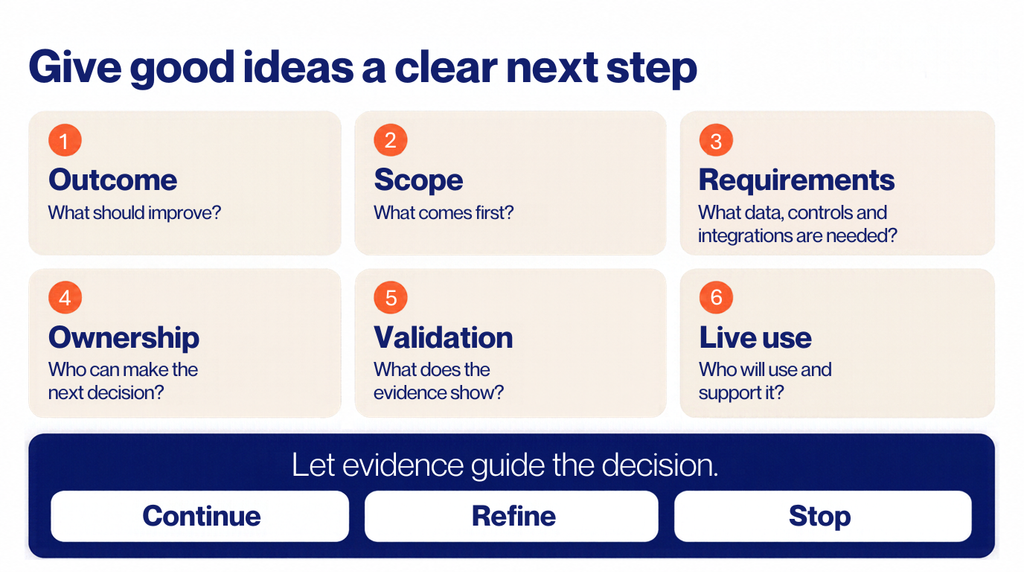
A repeatable pathway connects the following activities. Teams revisit earlier decisions as evidence changes; the sequence should support learning without losing accountability.
- Frame the business problem. Name the business owner, establish the baseline, and define the result worth pursuing.
- Shape the use case. Choose a manageable workflow or decision, involve its users, and agree on the evidence needed to proceed.
- Prepare AI-ready data. Identify Minimum Viable Data, the smallest set of trusted, well-defined data the use case needs. Resolve the access, quality and governance requirements for that use.
- Build and validate in the Sandbox. Test the solution and workflow in a governed environment, including relevant failure conditions and exceptions. Bring the right technical and control specialists into decisions early.
- Release to production. Consider security, compliance, and integration from the start through Path to Production. Agree on release authority, operational ownership, adoption and support before live use.
- Reuse and scale. Preserve useful assets, decisions and lessons. Check their fit for the next use case, and expand where evidence of value and operational viability supports the investment.
For the manufacturer, this means the service leader remains involved as the use case develops. IT helps establish the conditions for reliable operation. The people who answer customer requests test whether the proposed workflow helps them. Each group can see how its decisions contribute to the same outcome.
This is the problem Calibo’s approach to business innovation is designed around. Calibo is the new operating model for business innovation, working with customers’ existing technology investments and teams. Its Business Innovation Methodology turns complex challenges into focused, outcome-led use cases, with practitioners supporting delivery through AI Expertise and Enablement.
The Business Innovation Sandbox gives business and technology teams a governed environment connected to enterprise data and systems, separate from production. Teams can prepare data, build and validate use cases, and plan their path into live use. The aim is to make necessary enterprise complexity manageable for the people solving the business problem, while keeping business ownership and IT governance clear.
Make implementation the advantage
A useful review of a stalled idea starts with the next unresolved decision. Identify it, name who can make it, and agree on the evidence they need. The answer may justify a smaller scope, another experiment, a release decision or a stop. A clear decision is progress even when it changes the original plan.
Continue reading: Explore how an operating model connects experimentation to business outcomes.
Talk to Calibo about turning business challenges into outcomes that work in the real world.
The advantage comes from becoming better at turning the right ideas into outcomes that work.
FAQs
Should every promising idea reach implementation?
Experimentation should help leaders decide whether the value, feasibility, and operating requirements justify further investment. Stopping an idea because the evidence is unfavorable is a useful decision. Keep the reasoning and relevant lessons so later teams can benefit.
How can teams involve control specialists without expanding every meeting?
Identify the requirements and decision owners relevant to the use case. Involve specialists when their input can shape scope, design, or release criteria, and record decisions for others to use. Different stages need different participants; clear responsibilities help avoid repeated consultation.
Can this approach support innovation beyond AI?
Yes. The same questions about outcomes, ownership, data, controls, adoption and support apply to analytics, software, service and process innovation. The technical requirements change with the use case. AI should be selected when it is appropriate for the problem and supported by the evidence.
Trending articles

Data orchestration: why modern enterprises need a data orchestration platform
Data is pouring in from myriad sources—cloud applications, IoT sensors, customer interactions, legacy databases—yet without proper coordination, much of it remains untapped potential. This is where data orchestration comes in.

How Enterprise Architects can get more support for technology led innovation
Enterprise Architects are increasingly vital as guides for technology-led innovation, but they often struggle with obstacles like siloed teams, misaligned priorities, outdated governance, and unclear strategic value. The blog outlines six core challenges—stakeholder engagement, tool selection, IT-business integration, security compliance, operational balance, and sustaining innovation—and offers a proactive roadmap: embrace a “fail fast, learn fast” mindset; align product roadmaps with enterprise architecture; build shared, modular platforms; and adopt agile governance supported by orchestration tooling.

Why combine an Internal Developer Portal and a Data Fabric Studio?
Discover how to combine Internal Developer Portal and Data Fabric for enhanced efficiency in software development and data engineering.

The differences between data mesh vs data fabric
Explore the differences of data mesh data fabric and discover how these concepts shape the evolving tech landscape.