
An operating model for business innovation connects AI investment to governed execution, adoption, and measurable business outcomes.
Key takeaways
- An AI operating model connects business ownership and technology decisions from the first experiment through production and adoption.
- Focused use cases need trusted data, defined success measures and a path to production considered from the start.
- Measure technical performance, production readiness and sustained business impact separately. Reuse validated assets only where the next use case supports them.

When business units fund their own AI initiatives, a CIO can inherit responsibility for security and integration without a shared view of what those initiatives should deliver. The business has approved investment, and technology teams are managing the dependencies. Yet the route from a promising pilot to a measurable result remains unclear.
A business leader asks what changed in revenue, cost, or service quality. A data leader asks whether the information behind the result can be trusted. These questions belong in the same investment decision, but teams can end up answering them at different stages.
Technical limitations still matter. A model may be unsuitable for a task or too costly to operate. But when a pilot demonstrates useful functionality and still cannot advance, buying another tool may leave the underlying execution problem untouched.
The missing connection is an operating model for business innovation: a repeatable way to decide which ideas deserve investment, who owns the outcome, and what evidence is needed to advance them into production and adoption.
Why more tools leave the execution gap open
Consider an insurer testing AI-assisted claims triage. A demonstration may show that a model can organize claim information. It does not establish whether staff can use the output reliably, which decisions require authorization, or whether the complete workflow improves.
The initiative can stall because the target is unclear, relevant data lacks ownership, or integration and control requirements surface after validation. Buying another AI tool does not establish who owns the business outcome or what evidence the team needs before the solution can go live.
An AI operating model connects those decisions. The business owns the use case, outcome and its data. IT enables access and governs architecture, security, integration and release. Both participate from the start, with authority to resolve tradeoffs and a shared basis for continuing, changing direction, or stopping.
Five shifts that make AI innovation repeatable
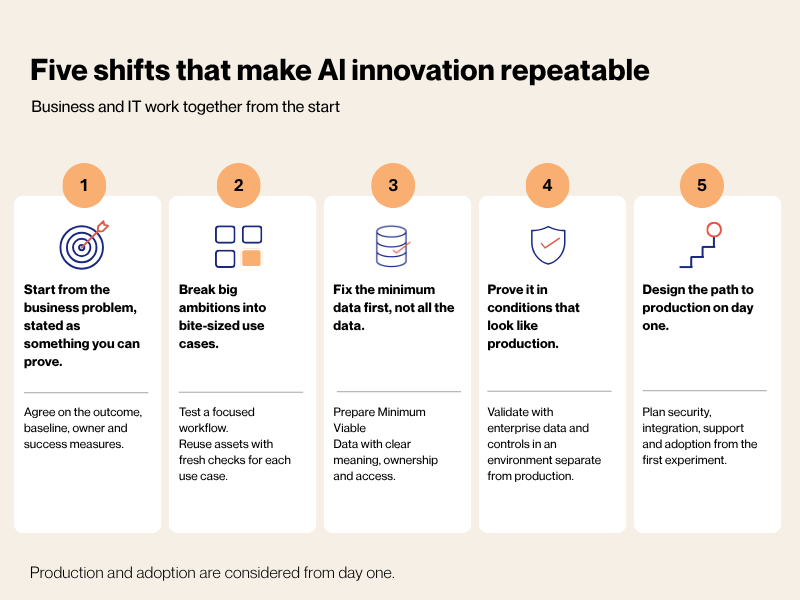
1. Start from the business problem, stated as something you can prove
“Explore AI for claims” describes an activity. A testable use case identifies what should improve, for whom and against which baseline.
For claims triage, that could mean reducing preparation time for one claim type while maintaining review quality. The business owner sets the target and timeframe with the people responsible for delivery. Technology teams assess feasibility and constraints.
Agreed measures give the team a clear basis for deciding whether to continue, change direction or stop.
2. Break big ambitions into bite-sized use cases
Start with a bounded workflow where the team can establish value and expose constraints. Define who will use the result, which systems it depends on and what is outside scope.
A smaller use case makes assumptions easier to test. It also gives leaders a basis for deciding whether expansion is justified. As use cases progress, validated assets and execution patterns can be reused where appropriate, f the data, context and controls required by the next use case.
3. Fix the minimum data first, not all the data
Minimum Viable Data is the smallest set of trusted, well-defined data needed for a use case. It focuses preparation on the outcome without lowering standards for quality or governance.
For the claims example, teams would identify the required records, agree on their meaning, and establish access permissions. They would also check whether policy guidance is current and who maintains it. This work can proceed alongside wider data improvement, provided the use case’s dependencies and risks are understood.
4. Prove it in conditions that look like production
Clean sample data can help establish feasibility. Further validation needs to examine how the solution behaves with relevant enterprise data, intended users, and realistic constraints.
Use a governed environment connected to enterprise data and systems, separate from production. Test how the solution handles missing information, incorrect outputs and exceptions. People responsible for reviewing AI-assisted actions need supporting evidence and authority to intervene.
In regulated or complex operations, these checks provide evidence for deciding whether a solution is ready to advance. They do not replace release checks or monitoring after deployment.
5. Design the path to production on day one
Security, compliance, and integration requirements should inform the first experiment. Teams also need release criteria, a support owner, and a plan for introducing the solution into daily work.
The business owner remains accountable for adoption and the intended result after deployment. IT governs release and supports reliable operation. Both should participate from the start, with clear responsibilities and agreed success measures.
Technical performance, production readiness, and business impact need separate measures so that reaching production is not mistaken for delivering sustained value.
What this looks like with Calibo
Calibo is the new operating model for business innovation. It brings methodology, a governed innovation environment, and expertise together, working with customers’ existing technology investments and teams.
The Business Innovation Methodology turns complex business challenges into focused, outcome-led use cases and reusable assets. Minimum Viable Data focuses preparation on the trusted information each use case needs.
The Business Innovation Sandbox is a governed environment connected to enterprise data and systems, separate from production. Teams can prepare data, build, and validate use cases, and plan their route into live use. Path to Production considers security, compliance, and integration from the start. AI Expertise and Enablement brings practitioners who help shape and deliver the work.
The aim is predictable, incremental outcomes that can compound as proven use cases expand. Each decision to reuse or scale should follow evidence of fit, adoption, and business value.
Where to start
Choose one business problem that matters this quarter. Bring its outcome owner and technology sponsor together to agree on the baseline, intended improvement, essential data, and conditions for advancing into live use.
If a key answer is missing, make it the next decision to resolve.
Use the Innovation Use-Case Canvas to frame the problem, identify dependencies, and agree on what evidence would justify continuing or stopping.
Want help shaping the use case with your business and technology teams? Talk to an expert.
FAQs
What is an AI operating model?
An AI operating model defines how an organization selects, funds, develops, deploys, and oversees AI use cases. It connects business ownership with data, technology and governance decisions, including how teams measure adoption and outcomes after release.
Who should own an enterprise AI use case?
The business owns the use case, outcome, and its data. A technology sponsor works with that owner to establish feasibility, access, architecture, and the path to production. Delivery, review and support responsibilities should be explicit so accountability continues beyond the pilot.
Does an operating model replace existing AI tools or governance?
It organizes how teams use existing investments and apply governance to specific business outcomes. Additional tools may be needed where a technical gap is demonstrated. An operating model helps teams evaluate that need alongside ownership, data readiness, integration, and adoption.
Trending articles

Data orchestration: why modern enterprises need a data orchestration platform
Data is pouring in from myriad sources—cloud applications, IoT sensors, customer interactions, legacy databases—yet without proper coordination, much of it remains untapped potential. This is where data orchestration comes in.

How Enterprise Architects can get more support for technology led innovation
Enterprise Architects are increasingly vital as guides for technology-led innovation, but they often struggle with obstacles like siloed teams, misaligned priorities, outdated governance, and unclear strategic value. The blog outlines six core challenges—stakeholder engagement, tool selection, IT-business integration, security compliance, operational balance, and sustaining innovation—and offers a proactive roadmap: embrace a “fail fast, learn fast” mindset; align product roadmaps with enterprise architecture; build shared, modular platforms; and adopt agile governance supported by orchestration tooling.

Why combine an Internal Developer Portal and a Data Fabric Studio?
Discover how to combine Internal Developer Portal and Data Fabric for enhanced efficiency in software development and data engineering.

The differences between data mesh vs data fabric
Explore the differences of data mesh data fabric and discover how these concepts shape the evolving tech landscape.