

Key takeaways
- AI can lower the cost of individual innovation activities while expanding the total number of opportunities an enterprise can pursue.
- Jevons Paradox is a useful lens for challenging the assumption that greater efficiency automatically means less total activity.
- The emerging enterprise bottleneck is conversion capacity: prioritizing, owning, validating, implementing and measuring the right opportunities.
- The entire enterprise data estate does not need to be perfect. The relevant business data for the use case must be trusted, owned, governed and understood.
- Production is an important milestone, but measurable business outcomes remain the destination.
AI is lowering the cost of analysis, development, and experimentation. The strategic challenge is no longer generating more possibilities. It is building the enterprise capacity to select the right opportunities and turn them into measurable business outcomes.
AI can accelerate research, analysis, software development, forecasting, concept creation and prototyping. Viewed one task at a time, that appears to support a straightforward conclusion: if AI performs more of the work, organizations should need less capacity to innovate.
But that conclusion assumes the amount of work is fixed.
When the cost of exploring an idea falls, more ideas become worth exploring. Questions that previously remained on a backlog can justify a closer look. Business functions can revisit opportunities that once appeared too expensive, slow, or technically difficult to pursue.
AI does not just make the existing queue move faster. It can make the queue longer.
For executives, that changes the management question. It is no longer only, “How do we give more people access to AI?” It becomes, “How do we select the right opportunities and convert them into measurable business outcomes?”
What Jevons Paradox means for enterprise AI
Jevons Paradox describes how an improvement in efficiency can lower the effective cost of an activity and stimulate enough additional demand to increase its total use.
Applied to AI, the relevant resource is cognitive and technical capacity: analysis, coding, design, forecasting, simulation, and experimentation. As these activities become faster and less expensive, organizations can apply them to more business questions, involve more functions and run more iterations.
In his July 2026 Apollo commentary, “Jevons Paradox: More Evidence of a Positive Employment Effect of AI Adoption”, Chief Economist Torsten Slok interprets the Ramp and Revelio Labs findings as evidence consistent with the idea that intensive AI adoption may complement workforce growth rather than simply replace workers.
Jevons Paradox should not be treated as a guarantee about every company, industry, or role. Its value is that it challenges the fixed-work assumption behind many replacement predictions.
A June 2026 working paper by Ara Kharazian, Lisa Simon, and Ryan Stevens, “A New Look at AI’s Impact on Jobs: Firm-Level AI Spending and Workforce Adjustment”, linked observed AI spending with workforce records across 21,559 US firms. High-intensity AI adoption was associated with 10.2% higher total headcount during the first 24 months after adoption, while low-intensity adopters showed no statistically significant change.
Those findings do not establish that AI caused the employment growth. The authors note that adopters were already larger, more technical, and faster-growing than other firms, and that early sector-level gains were uneven. For enterprise leaders, the useful implication is narrower: task-level automation does not necessarily reduce total activity or the opportunity set.
At the enterprise level, this can appear as a rapidly expanding portfolio of potential use cases. Commercial, operations, risk, and product teams can investigate more scenarios than before.
The ability to generate and test possibilities grows. The ability to convert them does not automatically grow with it.
Why more AI opportunities create a conversion bottleneck
Opportunity creation and opportunity conversion are different enterprise capabilities.
AI can help a team produce a compelling demonstration quickly. That demonstration must still connect to a business priority, use data the organization trusts, fit into an operating workflow, satisfy enterprise controls, earn user adoption, and improve a measurable result.
According to Lenovo’s official summary of the CIO Playbook 2026: The Race for Enterprise AI, based on research conducted by IDC among 3,120 IT and business decision-makers, 46% of AI proofs of concept had progressed into production. At the same time, only 27% of surveyed organizations had a comprehensive AI governance framework, while data quality, internal expertise, integration complexity, and organizational alignment remained significant constraints.
Reaching production is progress. It is not, by itself, proof of business value.
An AI use case can be live without changing the decision, workflow, customer experience, risk position, or financial measure it was intended to improve. It can produce accurate outputs but see limited adoption, sit outside the workflow, or fail to influence action.
The real destination is a measurable business outcome.
That makes enterprise conversion capacity the emerging bottleneck: the ability to prioritize the right opportunities, establish ownership, prepare the relevant business data, validate the use case, implement it within real-world constraints, and measure whether it delivers the intended result.
This is not primarily a question of protecting one team or function. It is a question of whether the enterprise can responsibly absorb and act on the much larger opportunity pipeline AI is creating.
How to turn AI opportunities into measurable business outcomes
Define the outcome and owner first
A strong AI initiative should begin with a business decision, workflow, product, customer experience, or operational result that needs to change. Rather than turning that challenge into a large transformation initiative, break it into focused, outcome-led use cases that can be tested, measured, and advanced independently.
Before selecting a model or building a prototype, the organization should agree on the intended outcome, the current baseline, who owns the result, which users must change how they work, how success will be measured, and which risks or tradeoffs are acceptable.
Business ownership should begin when the problem is defined—not after a technical team has completed a demonstration. Without an accountable owner, a use case can remain technically interesting while becoming operationally irrelevant.
Treat the relevant business data as a product
Enterprises do not need every piece of data to be perfect before innovation can begin.
They need the data required for the specific business use case to be trusted, owned, governed, and understood.
Treating data as a product means giving that relevant data clear definitions, accountable ownership, appropriate quality thresholds, governance and enough business context for decision-makers and users to understand what it represents.
That changes the readiness question from “Is all our enterprise data ready for AI?” to “Do we have the trusted business data required to support this outcome?”
The narrower question is more actionable. It allows the organization to begin with a focused use case, strengthen the data through real execution and expand its reusable data assets over time.
Technical architecture can support this work, but it should serve the business requirement rather than lead the story. The objective is not to perfect data in the abstract. It is to establish trusted business context for a decision, workflow, or measurable outcome.
For a deeper discussion of this principle, see Calibo’s practical enterprise playbook for moving from AI investment to business outcomes.
Plan for adoption, production and measurement from the start
Integration, governance, security, workflow fit, operational support, and user adoption should be considered while the use case is being shaped—not after a prototype has been approved.
Production is an important milestone, but it is not the final success measure. Teams should define three connected forms of success:
Technical: Does the capability perform reliably enough for the intended use?
Operational: Can it work within the enterprise’s workflow, systems, controls, and responsibilities?
Business: Does adoption improve the agreed result?
This prevents teams from treating deployment as value realization and ensures measurement continues after the capability enters live use.
Manage AI opportunities as a portfolio and reuse what works
As AI lowers the cost of experimentation, enterprises need stronger portfolio discipline.
Not every plausible use case deserves investment. Opportunities should be assessed against strategic relevance, business value, data readiness, risk, adoption requirements, and implementation effort. Teams also need explicit decisions about what should progress, be reshaped, or stop.
Reuse is equally important. Trusted business data, validated controls, delivery patterns, workflow components, and AI assets should not be rebuilt for every initiative.
Each successful outcome should strengthen the foundations available to the next use case. That is how a growing opportunity pipeline becomes manageable rather than overwhelming.
How Calibo helps enterprises build conversion capacity
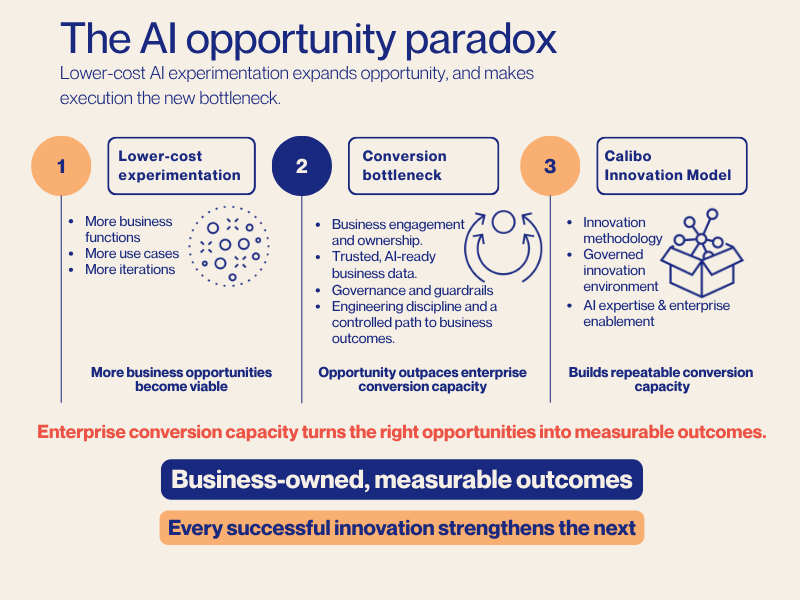
Calibo gives enterprises a repeatable way to turn business opportunities into real-world outcomes.
The Calibo Innovation Model connects outcome-led use cases, AI-ready data, a governed innovation environment, a controlled path to business outcomes and the expertise needed to build lasting capability.
It starts with the business problem, brings business, IT, data, and risk stakeholders into the process early, and helps teams validate what works within real enterprise constraints. It also supports evidence-based decisions about what to stop, refine, implement, and scale.
As successful work becomes reusable, each outcome can reduce the setup effort required for the next opportunity.
The objective is not to maximize the number of experiments or treat production as proof of success. It is to help enterprises repeatedly convert the right opportunities into measurable business value.
Measurable business outcomes are the destination
AI is changing the economics of innovation.
It lowers the cost of analysis, development, and experimentation, expanding the number of opportunities enterprises can realistically consider.
That does not make disciplined business innovation less important. It increases the value of the enterprise capabilities that turn possibility into results: clear priorities, accountable ownership, trusted business data, early governance, workflow adoption, disciplined execution and continuous measurement.
The advantage will not go to the organizations with the longest list of AI ideas, the most pilots, or even the fastest route to production.
It will go to the organizations that can repeatedly identify the right opportunities and convert them into measurable business outcomes.
AI lowers the cost of possibility. Enterprise conversion capacity determines how much of that possibility becomes value.
Explore how the Calibo Innovation Model helps enterprises turn a growing pipeline of AI opportunities into measurable business outcomes.
FAQs
What does Jevons Paradox mean in the context of AI?
Jevons Paradox describes how an efficiency improvement can reduce the effective cost of an activity and stimulate additional demand. With AI, lower-cost analysis, coding, design and experimentation can make more business opportunities worth investigating. It is an economic lens, not a guarantee that every organization, industry or job category will expand.
Why can more AI opportunities become an enterprise bottleneck?
AI can increase the number of use cases an organization can identify and test without automatically increasing its capacity to prioritize, govern, implement and measure them. The resulting constraint is not access to ideas or models. It is the enterprise’s ability to convert the right opportunities into adopted, measurable outcomes.
Does all enterprise data need to be AI-ready before an organization begins?
No. An organization should begin with the business outcome and establish the relevant business data required for that use case. That data needs clear meaning, ownership, appropriate quality, governance and business context. It can then be strengthened and reused as the organization expands into additional use cases.
Is reaching production the same as delivering business value?
Production means the capability has been implemented in a live environment. Business value depends on whether people adopt it and whether it improves the decision, workflow, customer experience or measurable result it was intended to change. Production is part of the journey; the outcome is the destination.
- Torsten Slok, “Jevons Paradox: More Evidence of a Positive Employment Effect of AI Adoption”, Apollo, July 12, 2026.
- Ara Kharazian, Lisa Simon, and Ryan Stevens, “A New Look at AI’s Impact on Jobs: Firm-Level AI Spending and Workforce Adjustment”, Ramp and Revelio Labs, June 30, 2026.
- Lenovo, CIO Playbook 2026: The Race for Enterprise AI, with research insights from IDC, January 2026.
- Lenovo, “Research From Lenovo Reveals AI Is Paying Off, Yet Most CIOs Aren’t Ready for What Comes Next”, January 27, 2026.
Trending articles

Data orchestration: why modern enterprises need a data orchestration platform
Data is pouring in from myriad sources—cloud applications, IoT sensors, customer interactions, legacy databases—yet without proper coordination, much of it remains untapped potential. This is where data orchestration comes in.

How Enterprise Architects can get more support for technology led innovation
Enterprise Architects are increasingly vital as guides for technology-led innovation, but they often struggle with obstacles like siloed teams, misaligned priorities, outdated governance, and unclear strategic value. The blog outlines six core challenges—stakeholder engagement, tool selection, IT-business integration, security compliance, operational balance, and sustaining innovation—and offers a proactive roadmap: embrace a “fail fast, learn fast” mindset; align product roadmaps with enterprise architecture; build shared, modular platforms; and adopt agile governance supported by orchestration tooling.

Why combine an Internal Developer Portal and a Data Fabric Studio?
Discover how to combine Internal Developer Portal and Data Fabric for enhanced efficiency in software development and data engineering.

The differences between data mesh vs data fabric
Explore the differences of data mesh data fabric and discover how these concepts shape the evolving tech landscape.