
Key takeaways
- Engineering colleges across India are under pressure to improve placement outcomes, modernize curriculum, and strengthen industry relevance.
- An AI program partnership for engineering colleges in India needs to do more than add another certificate. It needs to help institutions strengthen employability by delivering practical programs faster.
- Calibo AI Academy is designed as an AI employability program that colleges can use to give students practical learning, structured onboarding, and stronger industry linkage.
Engineering colleges across India are under increasing pressure to improve employability outcomes, modernize curriculum, and prepare students for a job market reshaped by AI.
For engineering colleges, placement outcomes now carry more weight than ever. Industry expectations are changing faster. Students and parents are looking more closely at career relevance, not just degree completion. And as AI reshapes entry-level roles, colleges are facing a new challenge: learning AI tools alone is no longer enough to make students job-ready.
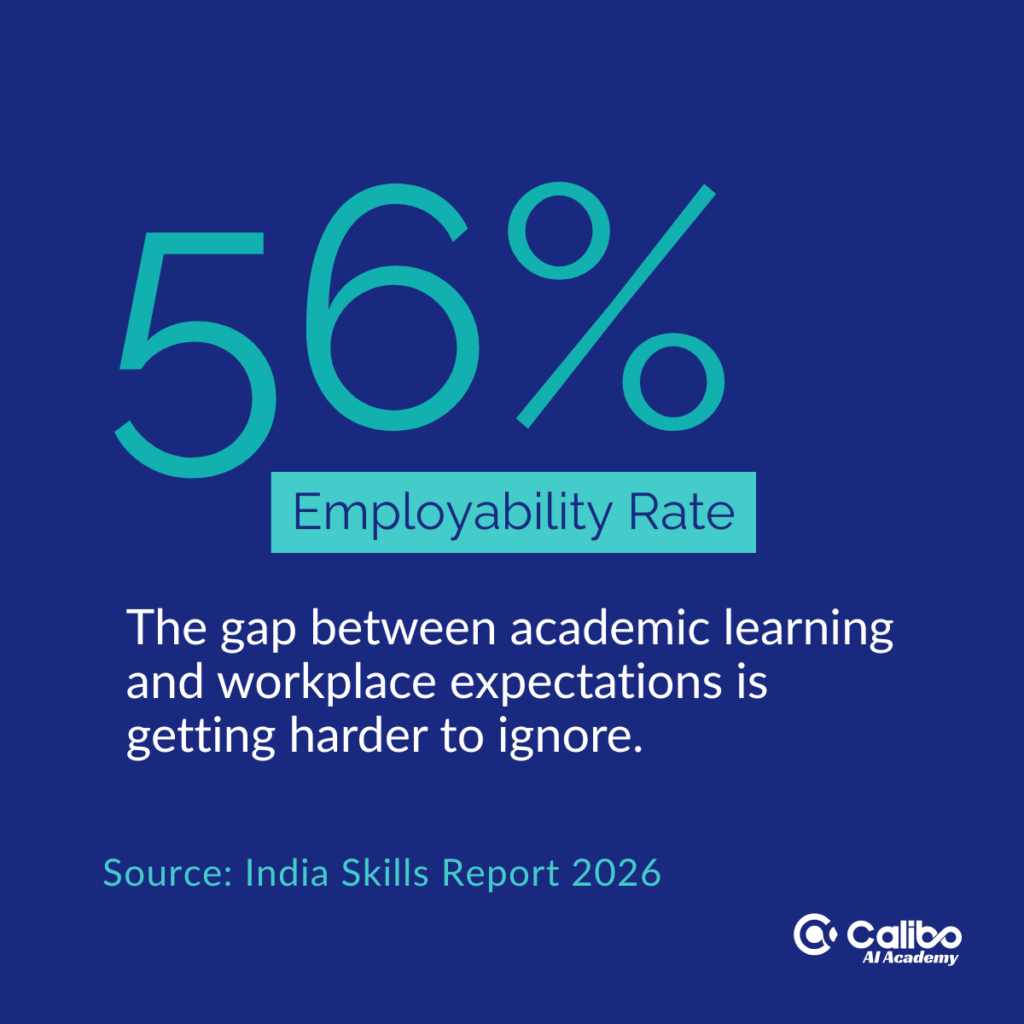
This shift is already visible at a broader level. The India Skills Report 2026 placed India’s employability rate at just 56%, showing that many graduates still need stronger job readiness before entering the workforce. For colleges, that makes the gap between academic learning and workplace expectations harder to ignore. At the same time, demand for digital and AI-related talent continues to grow, increasing pressure on colleges to prepare students for more applied, industry-relevant roles.
For Principals, Deans, Directors, and Training & Placement Heads, the challenge is no longer theoretical. Employers are looking for stronger applied capabilities, including hands-on experience, practical skills, and evidence that students can work on real business problems.
Many engineering graduates still need additional job readiness, and companies often invest considerable time in retraining fresh talent. That puts institutions under increasing pressure to respond with learning models that are more practical, industry-linked, and outcome-oriented. But very few institutions have the time, internal capability, enterprise access, or technical infrastructure to design and run a high-quality AI program on their own. That is where the partnership model becomes relevant.
Why AI employability matters for engineering colleges
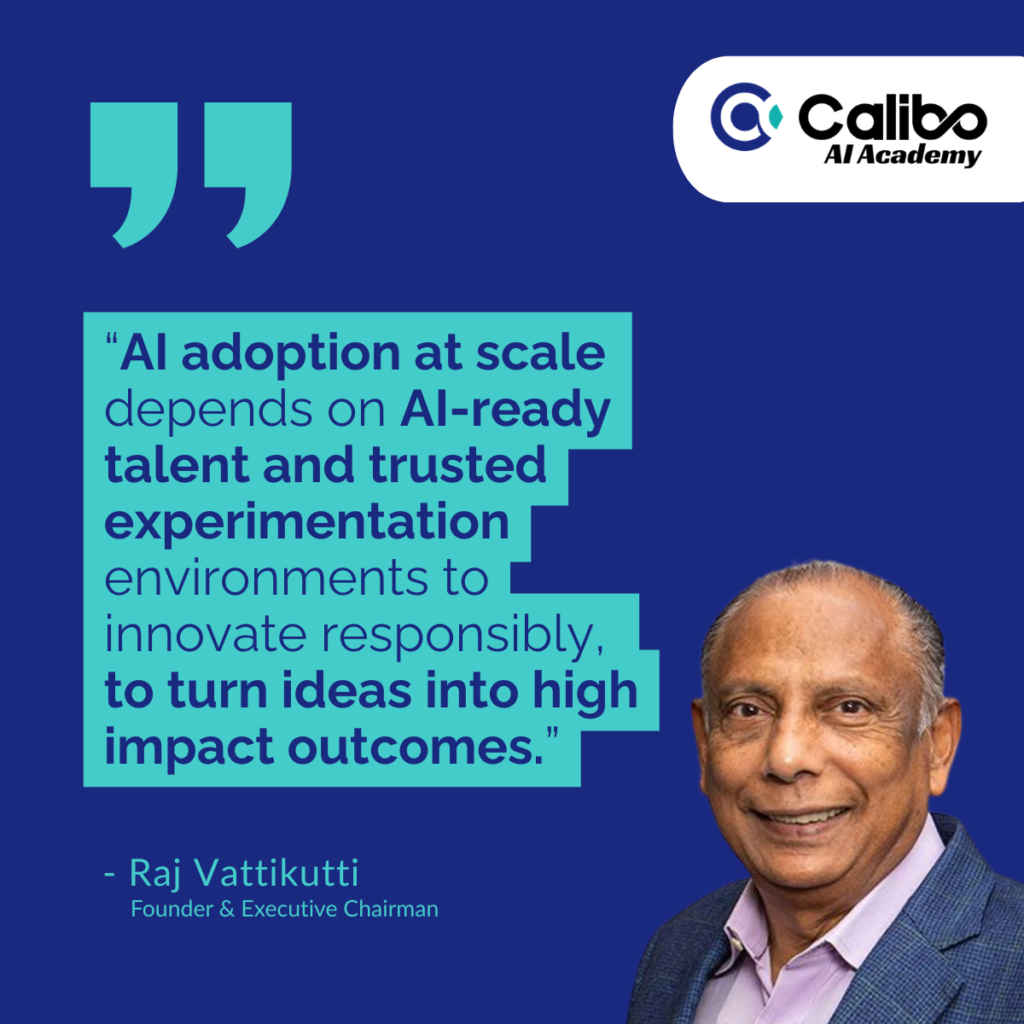
Traditionally, engineering graduates could enter organizations with a theoretical base and develop practical capabilities over time through fresher training and on-the-job exposure. But as AI changes the nature of entry-level work, that model is becoming less reliable. Employers increasingly need talent that can contribute on day one, work on practical use cases, and translate business problems into smaller, implementable AI opportunities.
The challenge, then, is not interest in AI. It is implementation. Building an effective AI program requires much more than selecting a curriculum. It needs program design, student onboarding, industry context, practical use cases, assessments, and a technical learning environment that goes beyond classroom theory. That is why an AI program partnership for engineering colleges in India has to be practical, not just aspirational.
Calibo AI Academy: A new model for AI employability
The Calibo AI Academy is an applied AI learning and employability model designed to help colleges prepare students for real-world AI work. Rather than functioning as another generic add-on course, it combines our applied AI curriculum, leveraging the Calibo Digital Business Innovation Methodology, and our purpose-built AI experimentation environment to create a more practical, industry-linked learning experience.
The model is designed to help students move beyond theory and tool familiarity. It gives them exposure to business problem-solving, structured innovation thinking, and hands-on AI application in a practical environment. For colleges, that means a more outcome-oriented way to strengthen career readiness without having to build the full program architecture from scratch.
What the partnership offers engineering colleges and students
1. Stronger employability positioning
Many AI learning options still focus mainly on tools. Colleges, however, are being evaluated more on outcomes.
The Calibo AI Academy is built to help students connect AI learning to business problems, applied projects, and workplace relevance. Instead of treating AI as a standalone theory layer, the model is designed to help colleges give students more practical exposure and stronger career readiness.
2. A more credible employability story
For college leadership, credibility is increasingly shaped by whether a program is structured, outcome-oriented, and aligned to current industry needs. The Calibo AI Academy’s partnership with the Andhra Pradesh government strengthens its credibility and adds institutional weight to the model. It helps colleges show that they are not only updating curriculum conversations but also building a stronger bridge between learning and employment.
3. Enterprise exposure through partnership
One of the clearest advantages of the model is that colleges do not need to create the full structure on their own.
The partnership brings together applied curriculum, onboarding support, and ready-to-deploy employability pathways. It also gives students exposure to enterprise-style problem-solving through real business use cases and practical AI application in the Sandbox environment. That is significant because these are the kinds of experiences colleges often find difficult to replicate independently. In turn, the partnership reduces the time, cost, and operational burden of building a high-impact AI initiative quickly from scratch.
4. Institutional value beyond the classroom
Beyond student learning, the model can help colleges strengthen their positioning in applied AI education through structured implementation, industry-linked learning, and stronger employability signaling. For institutions looking to improve placement conversations and demonstrate relevance in an evolving job market, this creates a clearer institutional advantage.
How the partnership works in practice
A college partnership works best when the process is clear.
The Calibo AI Academy is designed to move in a structured way: institutional discussion and alignment, MoU, campus orientation, student selection, onboarding, and program launch. This structure helps colleges align around AI employability, deliver AI practitioner training in a more applied format, expose students to enterprise use case development, and create clearer pathways toward internships and pre-placement offers (PPOs). This is important because many programs sound promising at the concept stage but become difficult to execute once implementation begins.
A practical model helps colleges move from interest to action. It gives structure to how students are introduced to the program, how selection happens, and how learning begins. It also makes it easier for institutions to evaluate fit without taking on the full burden of program design on day one.
Why this is not just another AI course
A generic AI course may help students learn concepts or tools. But that does not automatically translate into stronger placement relevance.
The Calibo AI Academy is designed around a combination of applied AI curriculum, the Calibo Digital Business Innovation Methodology, and the Calibo AI Innovation Sandbox. Together, these elements are meant to move learning beyond theory and toward practical application.
The Calibo Digital Business Innovation Methodology helps students break complex enterprise problems into implementable AI use cases and approach applied problem-solving in a more structured way. The AI Innovation Sandbox complements this by giving students a practical environment for experimentation, use case prototyping, and applied AI solution development. That makes the experience meaningfully different from a tool-only program.
For colleges, that difference matters because employability is increasingly tied to how well students can demonstrate applied capability, not just course completion.
How colleges in Andhra Pradesh and elsewhere are emerging as early adopters
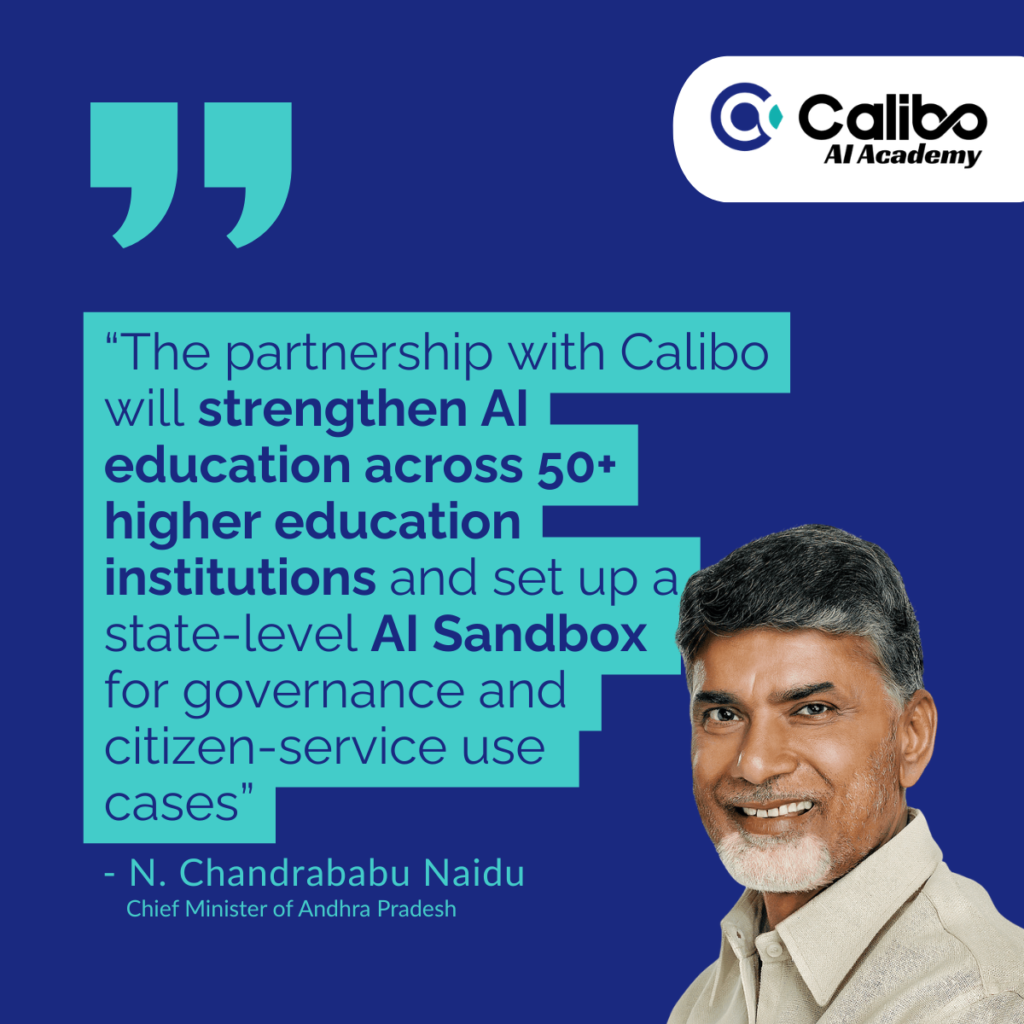
In Andhra Pradesh, the AI implementation challenge is gaining urgency within a broader push toward future skills and AI readiness. Government-backed initiatives and partnership-led models are creating stronger momentum for institutions to explore more practical approaches to employability. Within that context, the Calibo AI Academy’s partnership with the Andhra Pradesh government is helping bring a structured AI employability model to colleges across the state.
Andhra Pradesh colleges are not looking for AI branding for its own sake. They are looking for practical ways to improve placement conversations, modernize curriculum and learning models, strengthen industry relevance, and do so without taking on the full burden of program design alone.
That is why the partnership model is getting attention.
For institutions evaluating an AI program partnership for engineering colleges in India, the question is not whether AI is relevant. It is whether the model is practical, credible, and aligned with employability outcomes.
That is where Calibo AI Academy is designed to create value.
As Andhra Pradesh emerges as an early adopter in AI talent development, colleges have an opportunity to adopt a more practical pathway to enterprise-ready AI practitioners. That is the shift the Calibo AI Academy is designed to support.
To explore whether this AI model aligns with your institution’s priorities, connect with the Calibo AI Academy team or visit Calibo AI Academy page to learn more.
FAQs
1. What kind of outcomes can colleges expect from the program?
The program is designed to improve student employability by building practical AI problem-solving capabilities. Students gain exposure to enterprise use cases, applied AI development, and portfolio-building opportunities that can strengthen their placement readiness.
2. How does the AI Academy program support student placements?
The program focuses on building industry-relevant AI practitioner skills. Students work on applied projects and enterprise use cases that demonstrate real problem-solving capability, which can strengthen placement conversations and career opportunities.
3. Does the institution need to build new infrastructure to run the program?
Institutions do not need to build the infrastructure from scratch. A minimum setup includes: smart classroom, 1:1 laptop access, high-speed internet, projector/AV setup, and lab access. Optional enhancements include: dedicated AI Lab branding and co-branded innovation space.
Trending articles

Data orchestration: why modern enterprises need a data orchestration platform
Data is pouring in from myriad sources—cloud applications, IoT sensors, customer interactions, legacy databases—yet without proper coordination, much of it remains untapped potential. This is where data orchestration comes in.

How Enterprise Architects can get more support for technology led innovation
Enterprise Architects are increasingly vital as guides for technology-led innovation, but they often struggle with obstacles like siloed teams, misaligned priorities, outdated governance, and unclear strategic value. The blog outlines six core challenges—stakeholder engagement, tool selection, IT-business integration, security compliance, operational balance, and sustaining innovation—and offers a proactive roadmap: embrace a “fail fast, learn fast” mindset; align product roadmaps with enterprise architecture; build shared, modular platforms; and adopt agile governance supported by orchestration tooling.

Why combine an Internal Developer Portal and a Data Fabric Studio?
Discover how to combine Internal Developer Portal and Data Fabric for enhanced efficiency in software development and data engineering.

The differences between data mesh vs data fabric
Explore the differences of data mesh data fabric and discover how these concepts shape the evolving tech landscape.
