
Insights from Raj Vattikuti’s Industry–Academia Leadership Roundtables with higher-education leaders in Vijayawada and Visakhapatnam
Artificial intelligence is moving rapidly from experimentation into everyday business decisions, products, workflows, and customer experiences.
For engineering students, that creates enormous opportunity. It also changes what preparation may matter as they move from college into industry.
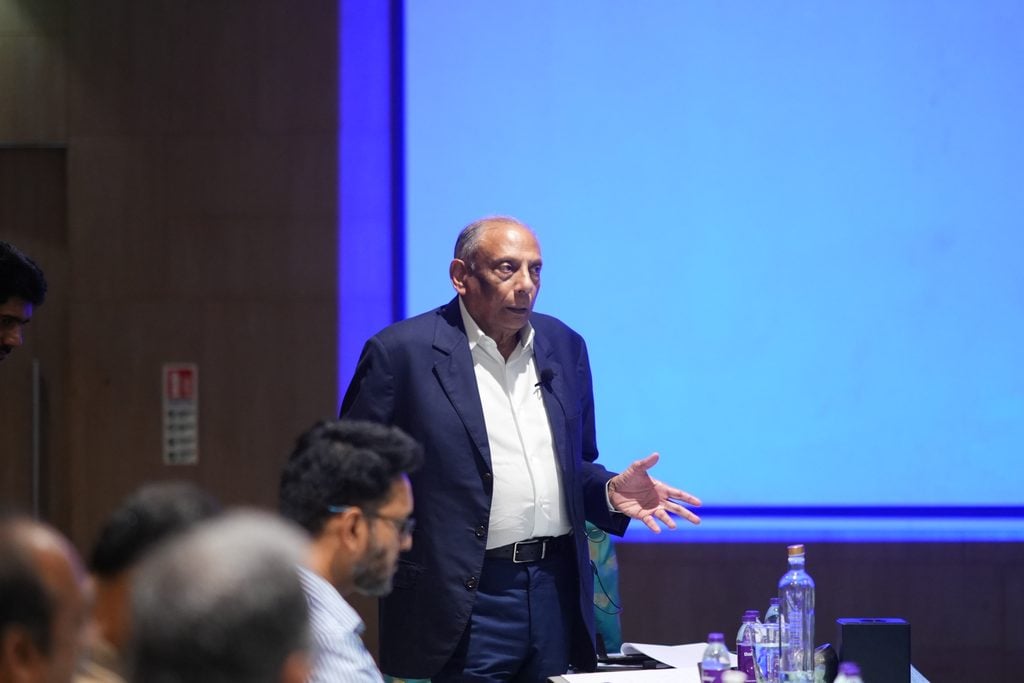
That question shaped two invitation-only Industry–Academia Leadership Roundtables hosted during Calibo Founder and Executive Chairman Raj Vattikuti’s visit to Andhra Pradesh:
- 11 September 2026 — Vijayawada
- 12 September 2026 — Visakhapatnam
The roundtables brought Raj together with academic leaders from across Andhra Pradesh for focused conversations on how enterprise AI is evolving, how talent expectations are changing, and how industry and academia can prepare students for what comes next.
One idea remained consistent throughout: AI needs to be understood in the context of real problems, real business use cases, and real outcomes—not simply as another collection of tools or agents.
Looking at AI through the lens of business change
Raj brought a perspective shaped by decades in the technology industry and experience across multiple waves of enterprise change.
Every major technology transition raises familiar questions:
- What will disappear?
- Which jobs will change?
- Which technologies should students learn?
- What will industry expect next?
AI adds urgency because the technology itself is evolving unusually quickly.
Today, AI can generate code, summarize documents, create content, analyze data, and automate increasingly sophisticated workflows. The obvious response may be to teach students more AI tools. But that risks missing the larger opportunity.
Start with the problem, not the tool
The more important question is whether students can use AI and other technologies to understand and solve meaningful problems.
Inside enterprises, technology rarely starts with:
“Which AI tool should we use?”
It starts with questions such as:
- What business problem are we trying to solve?
- Who is affected?
- What data do we have?
- What outcome would represent success?
- Where can AI genuinely improve the process?
That distinction—between learning AI and learning to solve problems with AI—became an important thread throughout the roundtables.
Raj repeatedly connected AI with business use cases, industry challenges, and practical problem-solving rather than presenting AI as an end in itself.
AI should be approached as an opportunity—not simply a threat
Much of the public discussion around AI and jobs begins with anxiety.
Will AI replace software engineers? What about coding, will it become less important? Will companies need fewer graduates? What happens when AI systems can perform tasks previously assigned to junior professionals?
These are legitimate questions. But they represent only one side of the change.
Every major technology shift also creates new problems to solve, new products to build, new businesses to launch, and new categories of work.
The opportunity is to work with AI intelligently
For students, the advantage may lie less in competing with AI on tasks it can automate and more in developing the judgment needed to work with it effectively.
That includes the ability to:
- understand a problem before producing an answer;
- question AI-generated outputs instead of accepting them automatically;
- connect technology choices with business value;
- combine data, models, APIs, workflows, and human expertise into complete solutions; and
- evaluate whether an AI solution is useful, reliable, and appropriate.
When AI can generate more of the output, human judgment becomes more—not less—valuable.

Beyond placements: students as AI innovators and entrepreneurs
Raj also encouraged institutions to think beyond conventional placement outcomes.
Engineering students can become AI innovators and entrepreneurs, not only candidates preparing for jobs.
India’s AI opportunity will not be measured solely by the number of AI professionals hired. But also by how many young engineers use AI to:
- build companies;
- create intellectual property;
- solve local and industry problems; and
- develop new solutions across healthcare, agriculture, manufacturing, financial services, education, and other sectors.
The role of engineering institutions is evolving too
None of this diminishes the importance of academic education.
Strong engineering fundamentals, mathematics, computing concepts, analytical reasoning, research, and disciplined learning remain essential.
Universities operate through structured curricula, academic calendars, and degree programs. Industry technologies and implementation practices can change much faster.
Expecting institutions to redesign their curriculum whenever a new model, framework, or AI tool appears would neither be realistic nor particularly useful.
Build stronger bridges instead
A more practical approach is to create stronger connections between academic foundations and enterprise practice.
The possibility of an apprenticeship-style learning model was discussed, in which practical experience would become part of the educational journey rather than something students encounter only after coursework.
Other participants discussed:
- deeper industry involvement in practical learning;
- engagement beyond conventional internships and occasional guest lectures; and
- pilot or proof-of-concept approaches that could demonstrate applied learning in practice.

The industry–academia gap is no longer only about technical skills
The phrase industry–academia gap has been used for years, often to describe whether graduates know the latest programming languages or technologies.
AI makes the gap more nuanced.
It increasingly exists:
- between understanding a concept and applying it;
- between building a model and building a usable solution;
- between completing a project and explaining the problem it solves;
- between generating an AI response and determining whether it is accurate, appropriate, or useful; and
- between technical execution and working effectively with business, product, data, design, and other disciplines.
This is where stronger industry–academia collaboration can add value without competing with the university curriculum.
Academic institutions bring foundational learning, faculty expertise, structured development, and access to large communities of young talent.
Industry brings changing business problems, implementation experience, practitioners, enterprise workflows, and visibility into what organizations expect from early-career professionals.
From guest lectures to continuous industry exposure
Students benefit when practitioners expose them to genuine business problems, question their assumptions, review their projects, and explain why an apparently impressive technical solution might still fail in a real enterprise environment.
Industry engagement can take many forms: masterclasses, real use cases, capstone reviews, hackathons, proof-of-concept sessions, portfolio reviews, demos, and mock interviews.
Industry learns too
This relationship works both ways.
Companies and practitioners gain a better understanding of what students already know, where they struggle, and how educational institutions are responding to rapid technology change.
AI education also needs a responsible innovation mindset
As students gain access to increasingly powerful AI technologies, another capability becomes essential: understanding when and how AI should be used responsibly.
A technically functional solution is not automatically a good solution.
Future AI practitioners need to ask:
- Is AI appropriate for this problem?
- Can the underlying data be trusted?
- How should the output be evaluated?
- What happens when the system is wrong?
- Where should human judgment remain involved?
Responsible innovation is not separate from technical capability.
The ability to build quickly must be accompanied by the ability to question, validate, test, and improve.
What does enterprise readiness look like in practice?
An enterprise-ready AI practitioner does not need to know every new framework.
They need to combine multiple capabilities.
They can connect technology with context
An enterprise-ready practitioner can:
- understand the business problem and intended outcome;
- choose and apply appropriate technology;
- build and evaluate a solution;
- collaborate across disciplines;
- explain technical decisions clearly;
- respond constructively to feedback; and
- account for real-world constraints such as data, security, governance, cost, reliability, and user needs.
This broader view of enterprise readiness matters whether a student eventually joins a technology company, works in a GCC, pursues research, or launches a startup.

Where Calibo AI Academy fits into the conversation
Many of the themes discussed during the roundtables are reflected in the design of Calibo AI Academy.
The Academy works alongside participating institutions to add an applied, industry-oriented layer to academic learning through:
- real-world AI use cases;
- practitioner mentorship;
- industry masterclasses;
- the Business Innovation Methodology;
- hands-on experimentation in the Business Innovation Sandbox;
- portfolio development; and
- career preparation.
Depending on the student pathway, current programs span approximately 6–8 months and 350–400+ contact hours, combining technical development with business problem-solving and practical project work.
Early cohorts have already seen students secure ₹10 LPA+ offers—an encouraging indication of what stronger project exposure, mentoring, and career preparation can help students demonstrate.
The broader goal
Calibo AI Academy aims to help students become capable of:
thinking, building, explaining, and innovating with AI.
College leaders’ perspectives on practical learning, apprenticeship-style models, stronger industry participation, and proof-of-concept exposure provide useful input as Calibo AI Academy continues refining how it works with institutions across Andhra Pradesh.
From conversation to possibility
Engineering education will continue to provide the foundations students need. Industry can strengthen that foundation by bringing exposure to real business problems, current technology practices, practitioner perspectives, and the disciplines required to take an idea from exploration to meaningful application.
The Vijayawada and Visakhapatnam conversations reinforced that building this kind of talent will require continued engagement between academia and industry.
For Calibo, that means continuing to work alongside forward-looking institutions, practitioners, and ecosystem partners with a clear ambition: To help build enterprise-ready AI practitioners at scale—and create stronger pathways from campus potential to real-world impact.
Explore how Calibo AI Academy works with institutions to build enterprise-ready AI capability.
FAQs
Why is industry–academia collaboration becoming more important in the AI era?
AI technologies and enterprise practices are evolving rapidly, while academic programs must provide structured and durable foundations. Closer collaboration allows students to combine academic learning with exposure to real business problems, practitioner perspectives, applied projects, enterprise workflows, and changing workplace expectations.
Will AI reduce the importance of coding and engineering fundamentals?
AI can increasingly generate code and automate development tasks, but engineering fundamentals remain important. As AI handles more execution, skills such as problem framing, architecture, verification, debugging, critical thinking, integration, and technical judgment become even more valuable.
How does Calibo AI Academy support enterprise readiness for engineering students?
Calibo AI Academy works alongside participating institutions to add an applied, industry-oriented layer to academic learning. Students gain exposure to real-world AI use cases, practitioner mentorship, industry masterclasses, the Calibo Business Innovation Methodology, hands-on experimentation in the Calibo Business Innovation Sandbox, portfolio development, and career preparation. Depending on the pathway, current programs span approximately 6–8 months and 350–400+ contact hours.
Trending articles

Data orchestration: why modern enterprises need a data orchestration platform
Data is pouring in from myriad sources—cloud applications, IoT sensors, customer interactions, legacy databases—yet without proper coordination, much of it remains untapped potential. This is where data orchestration comes in.

How Enterprise Architects can get more support for technology led innovation
Enterprise Architects are increasingly vital as guides for technology-led innovation, but they often struggle with obstacles like siloed teams, misaligned priorities, outdated governance, and unclear strategic value. The blog outlines six core challenges—stakeholder engagement, tool selection, IT-business integration, security compliance, operational balance, and sustaining innovation—and offers a proactive roadmap: embrace a “fail fast, learn fast” mindset; align product roadmaps with enterprise architecture; build shared, modular platforms; and adopt agile governance supported by orchestration tooling.

Why combine an Internal Developer Portal and a Data Fabric Studio?
Discover how to combine Internal Developer Portal and Data Fabric for enhanced efficiency in software development and data engineering.

The differences between data mesh vs data fabric
Explore the differences of data mesh data fabric and discover how these concepts shape the evolving tech landscape.