
Key takeaways:
- NatureSweet cut time-to-value from a typical 12–18 months to 8 weeks by using an orchestrated, production-ready delivery path.
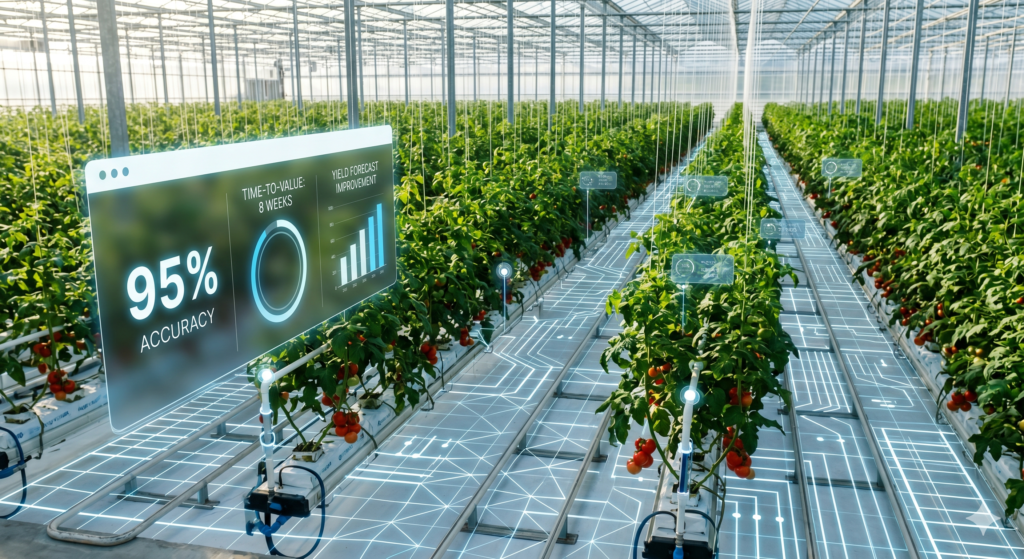
- Forecast accuracy improved from 88% to 95%, showing that speed and model performance do not have to compete.
- A governed platform with reusable components reduced development time across business applications by about 50%.
- The real differentiator was not just a better model, but a repeatable operating model for delivering AI in production.
If you cannot show value in weeks, you will be stuck explaining value for months.
NatureSweet, one of North America’s leading greenhouse growers, did not just improve model accuracy; it compressed the entire path to production from a “typical” 12–18 months to 8 weeks.
That is the difference between a cool pilot and a real business win the board can feel this quarter.
The situation: manual forecasting, slow signals, rising costs
Yield forecasting drives everything for a fresh-produce business—staffing, logistics, shelf availability, and waste. NatureSweet’s planners relied on manual forecasts and siloed systems, which kept accuracy below 88% and created downstream supply chain pain (late shipments, unmet demand, unhappy customers).
The move: orchestrate the path, not just the model
Instead of stitching tools together or launching another “pilot,” NatureSweet stood up a governed, end-to-end path with Calibo Business Innovation Sandbox.
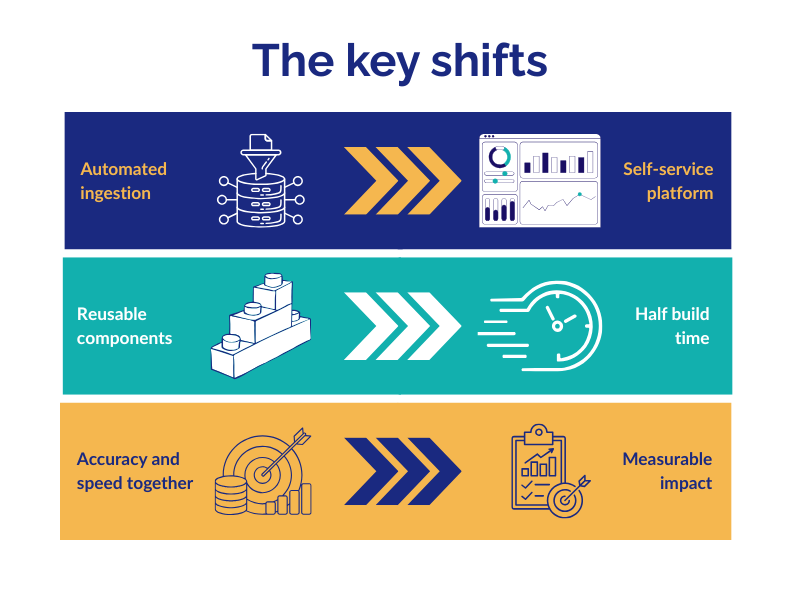
The shift was not just technical. It changed how the business consumed data, built applications, and measured value.
- Business users can access dashboards and run algorithms directly, without a ticket queue.
- Reusable components reduced application build time by about 50%.
- The forecasting service reached production in 8 weeks, improved accuracy from 88% to 95%, and increased produce saved from 754 to 904 tons.
NatureSweet’s CIO put it plainly: “Instead of building our own digital ecosystem, which would have taken 12–18 months, we were able to start within 8 weeks… improving yield forecasting by 7%, resulting in millions of USD in savings in the first three quarters.”
Why speed matters as much as accuracy
Accuracy often gets the spotlight. But in operations, time-to-value is the multiplier:
- Savings land in the same fiscal period: Short cycles let finance book gains now, not “after platform build-out.”
- Learning loops accelerate: You do not discover bad data contracts or performance bottlenecks in month 15; you catch them in week 3.
- Executive patience grows: Nothing buys more runway for AI than visible wins that close the loop fast.
NatureSweet’s speed had real-world effects beyond the model metrics: 904 tons of tomatoes were saved from potential waste per quarter, nd the orchestration reduced development time across business apps by about 50%.
Speed did not trade off accuracy; speed delivered accuracy where it counts, in production.
What changed operationally
The difference was not a secret algorithm; it was orchestration:
- Automated pipelines that normalize and enrich greenhouse data, so models ingest consistent, timely signals.
- A governed promotion path, the same path you will use later in scale—so there is no “rewrite for prod” tax at go-live.
- Templates and reusable ops for data jobs, dashboards, and services, which slash boilerplate and enforce quality gates.
- Self-service + guardrails, so planners see insights without waiting for developers, and developers move fast without violating policy.
Field lesson: redefine “done” to include time-to-first-value
Teams that win at AI delivery set success criteria beyond offline AUC:
- T2FV (time-to-first-value): How many weeks to a production pathway that someone uses?
- Unit economics: Cost per thousand predictions, per-pipeline run, per scenario.
- Operability: Rollback time, data contract adherence, lineage, and observability standards.
NatureSweet’s outcome hit all three: a fast path, measurable savings, and a production-ready service that can evolve.
How to apply this in your organisation (next 30–60 days)
– Start with an end-to-end walking skeleton. One orchestrated pipeline from source to dashboard to production endpoint. No side doors.
– Codify promotion gates. Data quality checks, model validation, security scans—pass to promote.
– Stand up a tiny template catalog. One pipeline template, one dashboard template, one microservice template—each with built-in logging, tests, and CI/CD.
– Instrument time-to-value. Put it on the same page as accuracy. Celebrate hitting both.
The payoff
NatureSweet did not just make a better forecast. They made a repeatable way to deliver AI outcomes, fast.
That is the lesson: design for time-to-value and accuracy together, and the compounding effect shows up as reduced waste, balanced inventory, and earned confidence—in weeks, not years.
Want to reduce time-to-value in your own AI delivery pipeline? Talk to our team.
FAQs
1. Why does time-to-value matter as much as model accuracy in AI projects?
Model accuracy alone does not create business value unless it reaches production quickly enough to influence operations. Time-to-value matters because it determines how soon teams can realize savings, improve decisions, and build confidence for broader AI adoption.
2. How did NatureSweet reduce the path to production from 12–18 months to 8 weeks?
NatureSweet reduced deployment time by using an orchestrated, governed delivery path rather than treating the initiative as a standalone model experiment. Automated pipelines, reusable components, self-service workflows, and built-in governance helped the team move from data ingestion to production much faster.
3. What business results did NatureSweet achieve from this approach?
NatureSweet improved forecasting accuracy from 88% to 95%, reached production in 8 weeks, delivered millions of USD in savings within the first three quarters, and increased produce saved from 754 tons to 904 tons.
Trending articles

Data orchestration: why modern enterprises need a data orchestration platform
Data is pouring in from myriad sources—cloud applications, IoT sensors, customer interactions, legacy databases—yet without proper coordination, much of it remains untapped potential. This is where data orchestration comes in.

How Enterprise Architects can get more support for technology led innovation
Enterprise Architects are increasingly vital as guides for technology-led innovation, but they often struggle with obstacles like siloed teams, misaligned priorities, outdated governance, and unclear strategic value. The blog outlines six core challenges—stakeholder engagement, tool selection, IT-business integration, security compliance, operational balance, and sustaining innovation—and offers a proactive roadmap: embrace a “fail fast, learn fast” mindset; align product roadmaps with enterprise architecture; build shared, modular platforms; and adopt agile governance supported by orchestration tooling.

Why combine an Internal Developer Portal and a Data Fabric Studio?
Discover how to combine Internal Developer Portal and Data Fabric for enhanced efficiency in software development and data engineering.

The differences between data mesh vs data fabric
Explore the differences of data mesh data fabric and discover how these concepts shape the evolving tech landscape.