
An AI experiment can succeed technically and still fall short of Business Innovation. A working model alone does not create business value. For an experiment to become Business Innovation, it must address a meaningful business problem and create measurable business outcomes. The business must also trust the underlying Business Data, govern the resulting assets, and be prepared to adopt and own them in Production.
Business teams may see opportunities to improve decisions, automate manual work, strengthen customer experiences, or increase Operational Efficiency. Technology, data, security, and governance teams must determine whether those ideas can work with enterprise data, integrate with existing systems, and meet other real- world requirements.
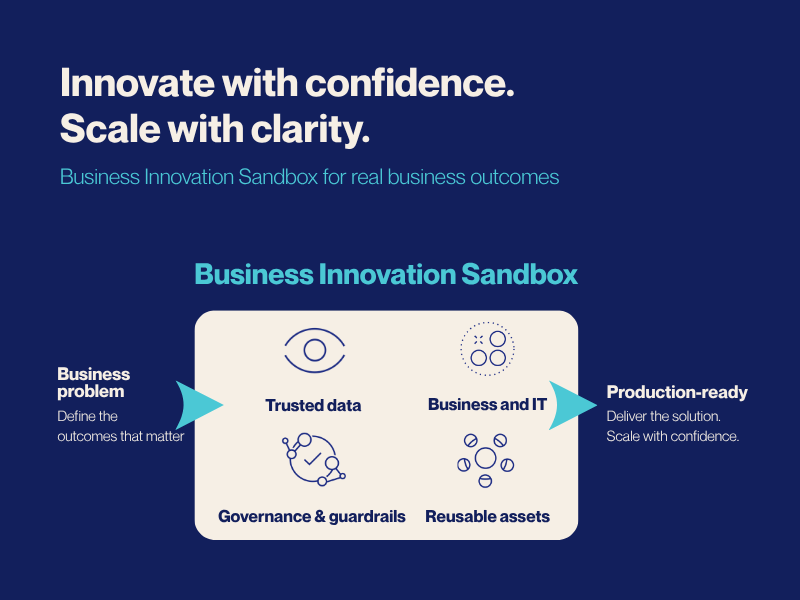
A generic technical sandbox can isolate experimentation, but it does not automatically connect the work to the business problem, trusted Business Data treated as reusable assets with Business Ownership, Engineering Discipline, and a path to Production. As one pillar of Calibo’s Innovation Model, the Business Innovation Sandbox provides that connection before change reaches Production.
Key takeaways
- A Business Innovation Sandbox separates experimentation from Production while keeping each use case aligned with business requirements and enterprise guardrails.
- Calibo’s Business Innovation Methodology starts with the business problem, breaks complexity into bite-sized, high-value use cases, and progressively builds Business Ownership.
- The Semantic Layer, Knowledge Graph, governance, and Engineering Discipline help create reusable Business Data as Products and AI and ML Assets that can move into Production and accelerate future Business Innovation.
Production is not designed for early-stage experimentation
Production environments exist to run the business. They support critical operations, customer interactions, reporting, regulatory obligations, and connections with other enterprise systems. Their priority is stability.
Experimentation serves a different purpose. Teams need room to test assumptions, assess data quality, compare AI or ML methods, refine workflows, and learn from business users. Introducing that uncertainty directly into Production can increase operational risk and slow learning because every early change must be treated as a Production change.
The answer is not to weaken controls. It is to separate experimentation from Production while keeping it connected to the business problem, trusted data, governance, and the requirements that will determine whether the work can move forward.
What a Business Innovation Sandbox does
A Business Innovation Sandbox is a secure environment where business and technology teams can experiment, validate ideas, prepare AI Ready Business Data and AI and ML Assets, and prove business value before moving into Production.
Within Calibo’s Innovation Model, the Business Innovation Sandbox evaluates more than technical feasibility. It must answer broader questions:
- Does the use case solve a meaningful business problem?
- Does the business understand and trust the data and resulting intelligence?
- Is Business Ownership clear?
- Have quality, security, compliance, governance, and traceability informed the work?
- Is there a pathway to Production once outcomes are validated?
That wider purpose keeps experimentation tied to Real World conditions. The objective is not a successful demonstration. It is Business Innovation that can be understood, governed, productionized, operated, and improved.
How Calibo’s Innovation Model connects the work
Calibo’s Innovation Model brings together three integrated pillars. The Business Innovation Methodology starts with the business problem and structures it into bite-sized, high-value use cases. The Business Innovation Sandbox provides the secure environment where business and technology teams can validate those use cases, prepare trusted Business Data and AI and ML Assets, and demonstrate measurable business value within enterprise guardrails. AI Deployment Talent brings practitioners, engineering leaders, and engineering teams that apply Engineering Discipline and help the business progressively build Business Ownership.
Together, these pillars connect Business Engagement, trusted Business Data, Engineering Discipline, and a path to Production. The sections that follow explain how that connection works throughout experimentation, validation, and preparation for Production.
Start with the business problem
Business Innovation should begin with the business problem, not the technology. Calibo’s Business Innovation Methodology breaks large initiatives into bite-sized, high-value use cases that teams can deliver and validate step by step.
This gives the business an active role from the beginning. Business teams define the desired outcome, explain the decisions or workflows involved, and help determine what a useful result looks like. Through continued Business Engagement, they gain experience with the use case and progressively build Business Ownership.
Within the Innovation Model, the Business Innovation Methodology structures the bite-sized use case, and the Business Innovation Sandbox provides the secure environment to validate it before it affects Production.
Build trusted Business Data and enterprise context
Enterprise AI cannot create trusted business outcomes from data the business does not understand or own. Innovation begins when data becomes a product. Data needs relevance, ownership, Master Data Management, governance, and the quality required to become AI Ready.
This does not require solving every enterprise data issue before work begins. The priority is to prepare the Business Data and AI and ML Assets required for the selected use case, with the context and governance needed to support a trusted result.
Within the Business Innovation Sandbox, the Semantic Layer and Knowledge Graph help transform fragmented data into governed business context. This gives Enterprise AI more accurate, explainable, and reusable knowledge while helping business teams understand and trust the intelligence produced.
Build guardrails and Engineering Discipline into experimentation
Formal security, risk, compliance, architecture, operations, and change-management reviews are essential before a validated use case moves into Production. Requiring every early experiment to pass through those processes at the outset, however, can slow innovation before the business outcome has been proven.
The Business Innovation Sandbox allows teams to begin quickly within built-in enterprise guardrails. The Business Innovation Methodology keeps the work focused on the business problem and measurable outcome, while AI Deployment Talent applies Engineering Discipline to the use-case design and execution. Quality, security, compliance, governance, and traceability considerations therefore inform the work during experimentation without triggering the full Production approval process too early.
Once the use case has demonstrated measurable business value and the organization decides to move it into Production, the appropriate enterprise teams are engaged to complete the required security, compliance, architecture, operational, and change-management assessments and approvals. The disciplined, traceable work created in the sandbox gives those teams a stronger foundation for their review.
This is structured learning within enterprise guardrails: teams can move quickly without ignoring critical requirements, while formal reviews occur when a validated use case is ready to progress toward Production.
Turn successful use cases into reusable assets
One-off pilots create limited value when their data definitions, intelligence, and engineering work cannot be reused. Teams may rebuild similar pipelines, integrations, and business context for each initiative, increasing duplication and Technical Debt.
A successful use case can instead create reusable Business Data as Products and AI and ML Assets. These assets retain trusted business context, ownership, and the Engineering Discipline developed through the work. A future initiative can build on what has already been established rather than start again.
Reuse does not mean applying the same result everywhere without change. It means contextualizing proven assets for another business problem while preserving the trusted business context and governance that make them valuable. This is how the Innovation Model compounds: every successful use case can strengthen the next.
Prepare validated Business Innovation for Production
The Business Innovation Sandbox is not the final destination. Its value depends on whether validated work can move into Production.
Before that happens, teams should be able to answer practical questions:
- Has the use case demonstrated business value?
- Does the business trust the Business Data and intelligence?
- Is Business Ownership clear?
- Have security, quality, compliance, governance, and traceability requirements been addressed?
- Can the assets be operated, reused, and continuously improved?
When these considerations inform experimentation, the organization has a stronger foundation for the formal assessments and approvals required before Production. It is not trying to retrofit an isolated proof of concept after the fact.
The enterprise need is larger than a place to test AI
Enterprises need a repeatable way to engage the business, prepare trusted Business Data, apply governance and Engineering Discipline, and move validated Business Innovation into Production.
Within Calibo’s Innovation Model, the Business Innovation Sandbox creates the secure environment for that work. It helps turn experimentation into Business Innovation proven in the Real World at Enterprise Scale.
Explore how Calibo’s Innovation Model helps enterprises move from AI experimentation to production-ready Business Innovation.
FAQs
How is a Business Innovation Sandbox different from a technical sandbox?
A technical sandbox primarily tests code, integrations, or models. The Business Innovation Sandbox also addresses Business Engagement, Business Ownership, trusted Business Data, governance, Engineering Discipline, and the requirements needed to move validated Business Innovation into Production.
How does the Business Innovation Sandbox support governance without slowing experimentation?
The Business Innovation Sandbox provides built-in enterprise guardrails, while the Business Innovation Methodology and AI Deployment Talent apply Engineering Discipline to use-case design and execution. This allows teams to experiment quickly while accounting for quality, security, compliance, governance, and traceability. Formal enterprise assessments and approvals occur once the use case has been validated and the organization decides to move it into Production.
What moves from the Business Innovation Sandbox into Production?
Validated Business Data, AI and ML Intelligence Assets—and the Business Innovation they enable—can move into Production after business value, Business Ownership, quality, security, compliance, governance, and traceability requirements have been addressed.
Trending articles

Data orchestration: why modern enterprises need a data orchestration platform
Data is pouring in from myriad sources—cloud applications, IoT sensors, customer interactions, legacy databases—yet without proper coordination, much of it remains untapped potential. This is where data orchestration comes in.

How Enterprise Architects can get more support for technology led innovation
Enterprise Architects are increasingly vital as guides for technology-led innovation, but they often struggle with obstacles like siloed teams, misaligned priorities, outdated governance, and unclear strategic value. The blog outlines six core challenges—stakeholder engagement, tool selection, IT-business integration, security compliance, operational balance, and sustaining innovation—and offers a proactive roadmap: embrace a “fail fast, learn fast” mindset; align product roadmaps with enterprise architecture; build shared, modular platforms; and adopt agile governance supported by orchestration tooling.

Why combine an Internal Developer Portal and a Data Fabric Studio?
Discover how to combine Internal Developer Portal and Data Fabric for enhanced efficiency in software development and data engineering.

The differences between data mesh vs data fabric
Explore the differences of data mesh data fabric and discover how these concepts shape the evolving tech landscape.