
A proven AI use case can create a starting point for the next portfolio company. By capturing reusable patterns, assets, and lessons, private equity operating teams can help teams avoid repeated discovery and advance the next business opportunity.
Key takeaways
- Proven business value in one company, then capture the patterns, assets, and lessons that could accelerate the next opportunity.
- Explore horizontal cross-portfolio solutions, industry-specific patterns, and company-specific innovation, identifying what can transfer and what needs adaptation.
- Measure business outcomes within each company and assess whether reuse shortens validation, avoids delivery effort or reduces time to measurable value.

An AI initiative reaches production at one portfolio company. Its business owner can show an improvement in the workflow, employees are using it, and the team understands what it takes to operate it. For a private equity operating partner, this creates a new question: could another company benefit from what the team has learned?
The answer depends on what made the initiative valuable. The business problem may recur elsewhere, while the data, systems and decision rights differ. A useful starting point may be the use-case design, evaluation criteria, or integration approach rather than the complete solution.
The portfolio opportunity follows a clear progression: prove what works, capture the pattern, assets and lessons, and use them to accelerate the next opportunity. A team could begin with tested evaluation scenarios, known integration dependencies, and lessons about adoption instead of discovering everything from scratch. That head start still needs to translate into a measurable business result.
Establish value before proposing reuse
A successful demonstration is a starting point. Before recommending expansion, an operating team needs evidence of what changed in the business.
Define the baseline and intended outcome with an accountable business owner. Assess the complete workflow, including review time, exceptions, and ongoing support. Check whether employees use the solution in practice and whether its operating costs support the business case.
Accountability also needs to survive deployment. Who can approve an AI-assisted action? When must a person intervene? Who investigates failures and can pause the workflow? Those answers should shape validation and release decisions from the start.
A solution that performs well in a pilot may still require more work before live use. Learning why it cannot advance is useful evidence, but it should not be presented as a proven portfolio success.
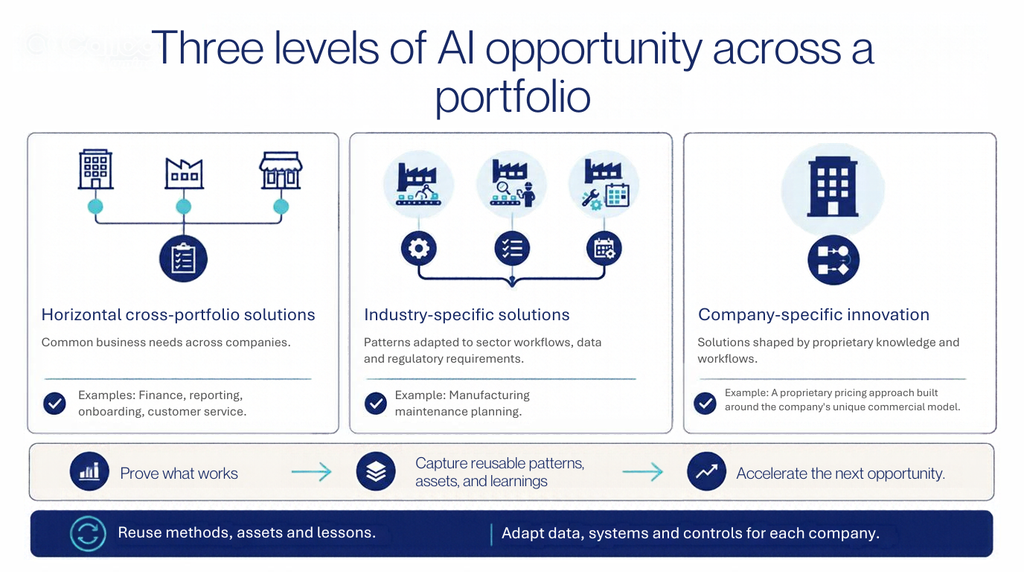
The three levels of AI opportunity across a portfolio help teams identify where proven patterns can be reused, where sector-specific adaptation is needed, and where company-specific innovation creates value.
1. Horizontal cross-portfolio solutions
Recurring needs such as finance automation, reporting, onboarding, and customer service can provide a starting point for evaluating reuse.
Consider an illustrative example. Suppose one portfolio company demonstrates that an AI assistant identifies missing invoice information and reduces the time finance staff spend preparing exceptions for review, with review effort included in the assessment.
The team captures the workflow design, data requirements, tested exception scenarios, and review checklist. It also records integration issues and what helped finance staff adopt the assistant.
A second company with a similar need could use this material to focus discovery, test known failure cases, and anticipate implementation work. Its accounting systems and approval thresholds may differ, but the team has a tested starting point for assessing the opportunity.
2. Industry-specific solutions
In an illustrative manufacturing example, suppose a company demonstrates that AI-assisted maintenance planning reduces the time planners spend preparing maintenance schedules while meeting agreed quality requirements.
The team captures the equipment-data requirements, evaluation scenarios, integration dependencies, and lessons from planners’ use of the recommendations.
Another manufacturer could use those assets to identify data gaps earlier, test familiar failure scenarios, and anticipate adoption challenges. Equipment types, failure histories, and sector-specific requirements may differ, so the reusable asset is the planning and evaluation pattern, adapted to the next manufacturer’s operations.
3. Company-specific innovation
Some opportunities depend on a company’s proprietary knowledge, customer relationships or distinctive way of working. Their value may come precisely from being difficult to reproduce elsewhere.
An operating team should assess these opportunities on their own business merits. Cross-portfolio applicability should not become a condition for funding every worthwhile use case.
Even where the solution remains company-specific, lessons about data preparation, testing, or adoption may help other teams. Reuse can mean avoiding a known mistake rather than sharing an application.
Capture what the next company can use
Once a use case has credible evidence behind it, capture more than the code or a presentation about the result. Give the next team enough context to judge relevance:
The business case: the problem, baseline, outcome measures, and conditions under which value was observed.
- Reusable assets: workflow designs, data definitions, approved components and evaluation scenarios that can be shared.
- Operating requirements: integrations, access controls, review responsibilities and support needs.
- Limits and lessons: failure modes, exceptions, assumptions, and changes made during delivery.
Make the captured material practical enough for another team to use. Tested evaluation scenarios could reduce repeated test design. Recorded integration dependencies could focus technical discovery. Adoption lessons could help the next team plan training and workflow changes earlier. Together, these assets give the next opportunity a more informed starting point.
Make the next investment a local business decision
The operating team can identify common needs and connect the next company with relevant assets and experience. Each receiving company needs a business owner accountable for the outcome and a technology sponsor who can assess feasibility and govern delivery.
Start with that company’s problem and baseline. Compare its workflow, data, systems, and controls with the original use case. Confirm which assets can be shared, what needs adaptation, and what requires fresh development. Portfolio ownership alone does not establish permission to share customer data or proprietary material. Validate the adapted solution before release, with clear responsibilities for review, support and adoption.
Measure progress in two ways. Within each company, assess the business outcome against its baseline, including operating costs, review effort, and sustained adoption. Across successive use cases, assess whether reuse changes the time needed to validate the next opportunity, the delivery effort required, or the time to achieve a measurable business outcome.
Use comparable scope and an agreed baseline or documented delivery estimate where possible. Record adaptation effort as well as work avoided. These are measures to investigate, not benefits to assume; pilot counts and shared-component counts cannot establish them.
How Calibo supports repeatable execution
Calibo is the new operating model for business innovation. It works with customers’ existing technology investments and teams to connect business-owned use cases with governed execution.
The Business Innovation Methodology helps teams turn business challenges into focused use cases and identify reusable assets. Minimum Viable Data focuses preparation on the smallest set of trusted, well-defined data each use case needs.
The Business Innovation Sandbox provides a governed environment connected to enterprise data and systems, separate from production. Teams can build and validate an adapted use case before release. Path to Production brings security, compliance, and integration into consideration from the start, while AI Expertise and Enablement help shape and deliver the work.
As teams deliver use cases, they can capture validated assets and delivery lessons for the next opportunity. Combining that accumulated knowledge with a consistent methodology could reduce repeated discovery and help teams anticipate execution challenges, while keeping measurable business outcomes central.
Start with one proven use case and one credible next opportunity
Choose one use case with evidence of operational value. Capture the workflow pattern, reusable assets, and delivery lessons. Then identify another portfolio company with a relevant business problem and use that knowledge to shape its next investment.
Make each completed use case a better starting point for the next. Tested scenarios can focus validation, known dependencies can guide integration planning, and adoption lessons can inform rollout. Assess whether that accumulated learning accelerates progress toward a measurable business outcome, then carry the findings forward again.
Talk to a Calibo expert about turning one proven use case into a starting point for your next portfolio opportunity.
FAQs
What can be reused from an AI use case across portfolio companies?
Reusable elements can include workflow patterns, data definitions, tested evaluation scenarios, approved technical components, and delivery lessons. These can give the next team a starting point for discovery, validation, and implementation. Reusing a pattern does not require copying the complete solution or transferring the original company’s data.
How should PE operating teams choose where to expand first?
Look for a material business problem, an accountable owner, and a technology sponsor at the receiving company. Compare data readiness, workflow requirements, and delivery effort with the original use case. Prioritize where the expected outcome and evidence justify the investment, rather than where the technology is easiest to copy.
How should portfolio-level AI value be measured?
Measure business improvement within each company against its baseline, including operating costs, review effort, and adoption. Separately assess time to validate subsequent use cases, delivery effort avoided, and time to a measurable business outcome, accounting for adaptation work. These measures help establish whether reuse creates an advantage rather than assuming that it does.
Trending articles

Data orchestration: why modern enterprises need a data orchestration platform
Data is pouring in from myriad sources—cloud applications, IoT sensors, customer interactions, legacy databases—yet without proper coordination, much of it remains untapped potential. This is where data orchestration comes in.

How Enterprise Architects can get more support for technology led innovation
Enterprise Architects are increasingly vital as guides for technology-led innovation, but they often struggle with obstacles like siloed teams, misaligned priorities, outdated governance, and unclear strategic value. The blog outlines six core challenges—stakeholder engagement, tool selection, IT-business integration, security compliance, operational balance, and sustaining innovation—and offers a proactive roadmap: embrace a “fail fast, learn fast” mindset; align product roadmaps with enterprise architecture; build shared, modular platforms; and adopt agile governance supported by orchestration tooling.

Why combine an Internal Developer Portal and a Data Fabric Studio?
Discover how to combine Internal Developer Portal and Data Fabric for enhanced efficiency in software development and data engineering.

The differences between data mesh vs data fabric
Explore the differences of data mesh data fabric and discover how these concepts shape the evolving tech landscape.