
Key takeaways
- The Calibo AI Academy is an 8-month employability pathway that complements college learning with industry-integrated curriculum, mentorship, hands-on labs, and real-world use-case building.
- The AI Academy program moves students through progressive capability layers: foundations, data and ML, deep learning, GenAI, RAG, agents, deployment, responsible Data and AI, capstone work, and placement readiness.
- The Calibo Business Innovation Methodology and Calibo Business Innovation Sandbox help students connect learning to business-centered execution by breaking complex problems into bite-sized Data and AI use cases.
Engineering colleges are already expected to prepare students for an AI-driven job market. The real differentiator is whether they can help students show practical evidence of readiness: the ability to frame business problems, work with data, build Data and AI solutions, and communicate outcomes in a way enterprises understand.
That is the gap Calibo AI Academy is built to address.
The AI Academy is built on Calibo’s experience of enabling business and technology teams to move from complex problems to structured, production-oriented solutions. Students are introduced to the same fundamental principles that guide enterprise innovation: start with the business problem, work with trusted data, break large challenges into achievable use cases, build through disciplined workflows, and evaluate success against measurable outcomes. This industry perspective is what distinguishes the Academy from a conventional technology training program.
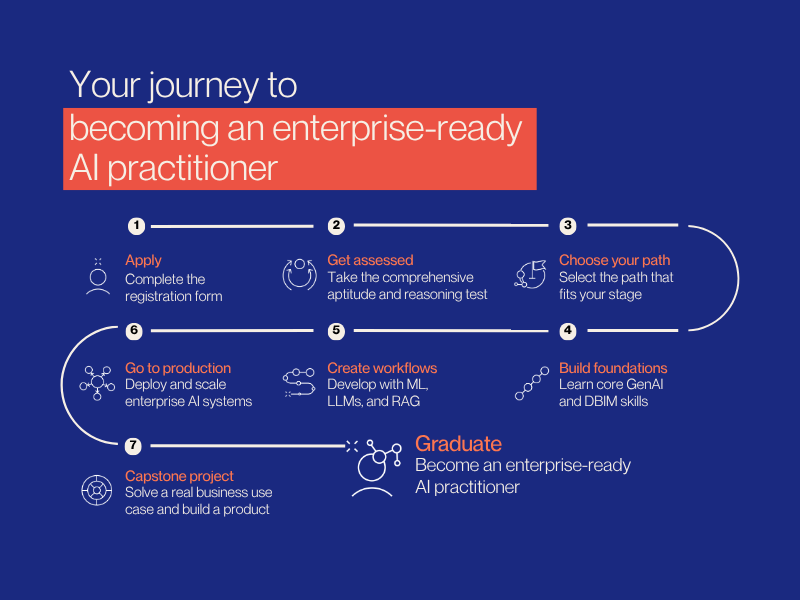
Across eight months, the program gives students a structured path from foundational learning to practical Data and AI execution, with industry mentorship, sandbox-based experimentation, capstone work, and placement readiness built into the journey.
For college leadership, the program offers a concrete pathway to strengthen employability without asking institutions to reinvent their curriculum from scratch. For students, it gives a clear view of what they will learn, build, present, and prepare for over eight months.
Choose the program path that fits your stage
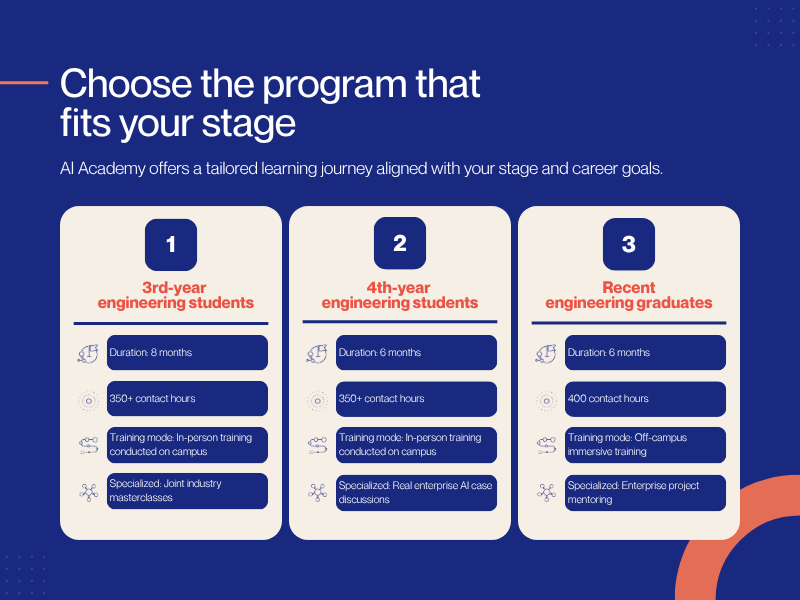
Calibo AI Academy offers learning pathways aligned to each student’s academic stage and career goals. The pathway for third-year engineering students takes eight months to complete. The pathways for fourth-year engineering students and recent engineering graduates take six months.
The month-by-month journey below follows the eight-month pathway designed for third-year engineering students.
Before month 1: Selection and readiness
The journey begins before the first class.
It starts with a four-step selection process: an online application, an online assessment, personal counseling, and confirmation. Once confirmed, students are onboarded to understand the program’s structure, time commitment, and expectations.
This stage matters because Calibo AI Academy is build-heavy. Students are expected not only to attend sessions but also to complete labs, participate in build sprints, submit work for review, engage with mentors, and progressively develop real-world use cases.
For college leaders, this selection and onboarding process creates clarity. It helps align students, faculty coordinators, and Academy mentors around a shared objective: employability through practical capability.
Month 1: Foundations and the business context for data and AI
The first month establishes the base.
Students begin with AI foundations, Python, math for machine learning, data basics, and an introduction to the Calibo Business Innovation Methodology. The goal is not to rush into advanced models. The goal is to help students understand how Data and AI systems are framed, built, evaluated, and connected to business outcomes.
Month 1 introduces a principle that guides the rest of the program: start with the business problem, not the technology. Students learn to identify the problem being solved, the data required, the intended outcome, and what would make the solution useful to a business team.
By the end of this phase, students begin developing the foundation of an AI-aware practitioner: someone who understands the basics of Python, data, math for machine learning, and business-centered problem framing.
Months 2–3: Data, classical machine learning, and problem solving
Once the foundation is in place, students move deeper into data handling and classical machine learning.
They work with SQL, exploratory data analysis, data cleaning, feature engineering, model building, and model evaluation. These skills help students prepare usable data, evaluate models, and understand what the output should help someone decide or do.
This phase is where students start becoming data-driven problem solvers. They learn to evaluate models, interpret results, and connect outputs to measurable goals. The curriculum reinforces business mapping concepts such as KPI alignment and ROI thinking, helping students understand that technical work must be tied to outcomes.
For students, this is often the point where AI starts to feel less abstract. They begin to see how data pipelines, business questions, and model evaluation fit together.
For colleges, it is the first visible signal that students are developing practical skills beyond classroom theory.
Months 4–5: Deep learning, GenAI, RAG, and agentic workflows
The middle of the program takes students into more advanced Data and AI concepts.
They work through deep learning, neural networks, embeddings, NLP, transformers, large language models, prompt engineering, RAG systems, and agentic workflows. The goal is not to chase every new tool. The goal is to help students understand how modern Data and AI systems are designed, orchestrated, and applied to real tasks.
This is also where workflow thinking becomes important.
A student may learn how a model works. But an employer needs someone who can understand how that model fits into a larger process: where data comes from, how a user interacts with the output, where guardrails are required, and how the work can be improved over time.
AI Academy’s curriculum reinforces this systems view. The curriculum breakdown describes four outcome layers: conceptual understanding, applied capability, system thinking, and business impact delivery. Students are expected to understand AI systems, build ML and GenAI solutions, design workflows rather than isolated models, and present solutions in a business-relevant way.
Month 6: Deployment, responsible Data and AI, and enterprise readiness
By month 6, students start connecting their builds to production-oriented thinking.
They learn about APIs, deployment, MLOps, governance, responsible Data and AI, monitoring, bias, and cost control. This stage helps students understand that building something that works in a notebook is not the same as building something that can be trusted in a business environment.
The Calibo Business Innovation Sandbox plays an important role here. It gives students a structured environment to experiment with use cases, tools, data workflows, and solution patterns without treating learning as a theoretical exercise.
This is one of the clearest differences between AI Academy and generic courses. Students are not only learning concepts; they are practicing how to build in a more governed, business-centered way.
Together, industry-focused learning, the Calibo Business Innovation Methodology, mentorship, and the Calibo Business Innovation Sandbox help students practice Data and AI execution in a more structured way.
Months 7–8: Real-world use-case building, capstone, and placement readiness
The final two months are where the program becomes especially concrete.
Students move into real-world use-case building. They work through build sprints, receive mentor feedback, refine their solution approach, and prepare to demonstrate what they have built. This is also where the capstone becomes important.
The capstone is one of the most important milestones in the journey because it gives students a way to demonstrate how they apply what they have learned.
Through the capstone, students can show how they approach a business problem, break it into bite-sized use cases, work with data, apply ML or GenAI where relevant, design a workflow, and connect the solution back to business KPIs.
The curriculum breakdown is clear that students do not simply complete mini-projects. Capstones are designed as end-to-end AI systems that may include data ingestion, a model or LLM layer, workflow orchestration, a UI layer such as Streamlit, and business KPI mapping.
This evidence matters for placement conversations. By the end of the program, students should have more than a certificate. They should have a practical story to tell: what they built, why it mattered, how they approached the problem, how they evaluated the result, and how they would improve it.
The program structure includes an 8-month learning journey, 15 hours per week, two months of real-world use-case building, industry mentorship, demo day preparation, and placement-readiness support. For students, this creates a clearer bridge from learning to internship and pre-placement conversations, where applicable. For colleges, it creates a more concrete employability signal than a standalone course completion badge.
What students build along the way
AI Academy use cases are designed to mirror the kinds of problems students may see in business environments.
Examples include support ticket triage and automation, revenue leakage analysis, contract or document processing, RAG-based knowledge assistants, back-office automation, chatbots, copilots, and business KPI prediction.
These examples matter because they show students how Data and AI connects to everyday enterprise work. A use case is not just a technical assignment. It is a way to practice business problem framing, data preparation, model or LLM selection, workflow design, governance, and communication.
That combination is what helps students become business-embedded Data and AI practitioners.

What students gain
For students, the biggest shift is confidence through practice.
They learn the tools, but they also learn how to use those tools in context. They work with business problems, build solutions, receive feedback, and prepare to explain their work to people who care about outcomes, not just code.
By the end of the 8-month journey, the goal is not simply to say, “I completed an AI course.” The goal is to say, “I can understand a business problem, break it into bite-sized use cases, work with data, build and evaluate a solution, and explain how it can create value.”
That is the difference between classroom exposure and career readiness.
Explore how the Calibo AI Academy can help your institution build enterprise-ready AI talent.
FAQs
How can college leaders evaluate student progress during the 8-month program?
College leaders can look beyond attendance or course completion and review how students progress through practical checkpoints. The program includes concept quizzes, lab submissions, build reviews, hackathons, capstone evaluation, and hiring simulation, giving institutions multiple ways to assess whether students are developing applied Data and AI capability over time.
How does Calibo AI Academy help students present their work during placement conversations?
Students learn to translate their project work into a clear, employer-facing narrative. Through use-case development, capstone work, and mentor feedback, they practice explaining the business context, the Data and AI approach, the workflow decisions, and the outcome their solution is designed to support. This helps them discuss their work with more confidence as they prepare for internships and early-career opportunities.
Why does sandbox-based learning matter for college students?
Sandbox-based learning helps students move from classroom exercises to structured experimentation. They can test ideas, work through Data and AI workflows, refine solution patterns, and understand how responsible experimentation supports business-centered execution.
Trending articles

Data orchestration: why modern enterprises need a data orchestration platform
Data is pouring in from myriad sources—cloud applications, IoT sensors, customer interactions, legacy databases—yet without proper coordination, much of it remains untapped potential. This is where data orchestration comes in.

How Enterprise Architects can get more support for technology led innovation
Enterprise Architects are increasingly vital as guides for technology-led innovation, but they often struggle with obstacles like siloed teams, misaligned priorities, outdated governance, and unclear strategic value. The blog outlines six core challenges—stakeholder engagement, tool selection, IT-business integration, security compliance, operational balance, and sustaining innovation—and offers a proactive roadmap: embrace a “fail fast, learn fast” mindset; align product roadmaps with enterprise architecture; build shared, modular platforms; and adopt agile governance supported by orchestration tooling.

Why combine an Internal Developer Portal and a Data Fabric Studio?
Discover how to combine Internal Developer Portal and Data Fabric for enhanced efficiency in software development and data engineering.

The differences between data mesh vs data fabric
Explore the differences of data mesh data fabric and discover how these concepts shape the evolving tech landscape.