
Start with the growth or efficiency result, then prepare the trusted data and capabilities needed to test a focused use case.
Key takeaways
- Let growth and efficiency outcomes determine AI priorities, with an accountable owner, a baseline and a credible business case.
- Prepare Minimum Viable Data for the use case, maintaining the quality, coverage and controls required for responsible use.
- Use focused delivery to test assumptions and strengthen readiness, then expand only where adoption and business evidence justify it.
AI value creation should start with a portfolio company’s value-creation plan. For private equity operating teams and company leaders, the first question is which growth or efficiency priority deserves investment and what is needed to pursue it now.
That priority should define a focused use case, an accountable business owner, and a measurable result. Teams can then identify the smallest sufficient set of trusted data, governance, and technology capabilities required to execute it.
A company may be able to pursue a specific opportunity, such as improving quote conversion or reducing operational delays, while broader modernization continues. The condition is that the data, controls, and capabilities needed for that use case are ready.
Which business outcomes should determine AI priorities?
Growth and operational efficiency should guide the initial discussion. Addressing the AI execution gap in private equity starts with turning a focused use case into a capability the business uses to improve a measurable result.
A growth objective might concern customer retention, quote conversion, or margin improvement. An efficiency objective might concern the time needed to resolve a service request or the effort required to handle an operational exception. Each needs a defined workflow and an owner who can change how the work happens.
Before choosing a solution, establish the baseline, desired improvement, and evidence needed to justify further investment. Compare the opportunity with other priorities in the value-creation plan, considering feasibility and total cost.
Keep the economics explicit. Time saved creates capacity, but its business value depends on how the organization uses it. A growth use case should account for margin and delivery costs as well as additional revenue. Include the cost of data preparation, implementation, human review, and ongoing support when judging either opportunity.
Why can waiting for perfect data delay value?
Waiting for an entire data estate to reach a uniform standard can delay use cases whose requirements are already within reach. One workflow may need reliable customer and transaction information without requiring every historical record across every function to be reconciled first.
Broader modernization remains necessary where shared identifiers, access controls, or unreliable source systems prevent a use case from proceeding. Connect those improvements to the business priorities they enable and resolve the critical dependencies before advancing.
What does Minimum Viable Data mean in practice?
Minimum Viable Data is the smallest set of trusted, well-defined data a use case needs. The business outcome defines its scope, while the intended workflow determines the required quality, context, coverage, and governance.
Narrow the scope of preparation while retaining the quality, coverage, and controls the use case requires.
Business and technology teams should agree on these requirements before building:
| Requirement | What the team must establish |
|---|---|
| Scope and coverage | The records, population, and history needed for the intended task, including relevant variation and exceptions. |
| Meaning and ownership | Agreed definitions, consistent identifiers, and a business owner who can resolve ambiguity. |
| Quality | Acceptance criteria for accuracy, completeness, and other qualities that affect the use case, with a response when checks fail. |
| Access and permitted use | Who may use the information, for what purpose, and under which privacy, security, and governance controls. |
| Ongoing operation | Required freshness, traceability, monitoring, and responsibility for maintaining the data after release. |
The NIST AI Risk Management Framework 1.0, published in 2023, emphasizes business context and the suitability and representativeness of data.
Trusted data enables the use case; preparing it does not itself demonstrate business value. Apply the same discipline to technology: use existing capabilities where they fit, with IT confirming the integrations and support needed for live use.
A growth use case from business outcome to trusted data
Consider an illustrative B2B distributor seeking to improve the conversion of open quotes into orders. This is a hypothetical example, not a reported Calibo customer result. The commercial leader owns the outcome.
- Define the outcome. Improve quote conversion, using current performance as the baseline.
- Identify the necessary data. Start with quote dates and values, customer identifiers, order outcomes, and follow-up history.
- Establish definitions and controls. Agree on what counts as an open quote, how revised quotes are handled, and who may access the records. Account managers retain responsibility for customer contact and pricing commitments.
- Test within a focused scope. Help account managers prioritize follow-up within one sales unit or product line, and compare the AI-assisted workflow with the existing process.
- Measure business results. Track conversion, margin, and whether account managers use the recommendations in their follow-up. Include review and follow-up effort when assessing the economics.
Use the evidence to decide whether further investment is justified.
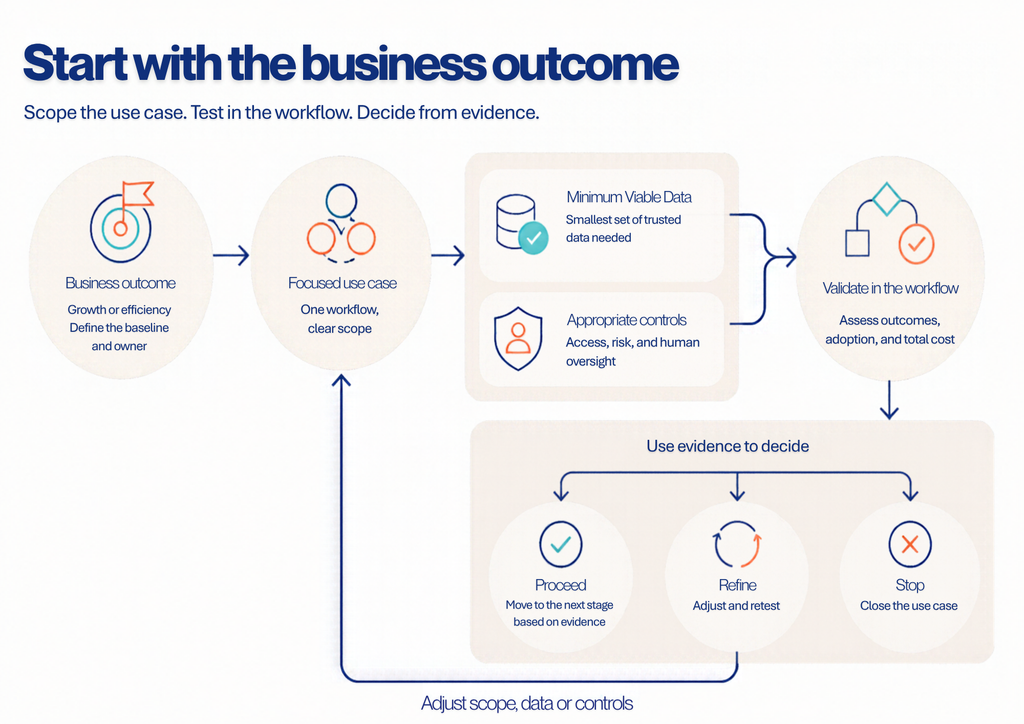
How do focused use cases strengthen AI and data readiness?
Each focused use case can establish useful definitions, quality checks, integrations, and delivery lessons. When documented and maintained, these foundations may support subsequent opportunities. In the distributor example, agreed quote and order definitions could help a later sales-planning use case, subject to its requirements.
These lessons also give the broader data roadmap evidence from real business needs. If several use cases encounter the same missing definition or integration, that evidence can help leaders prioritize a shared improvement and connect the investment to the outcomes it enables.
A smaller initial commitment also lets teams test important assumptions about data, workflow adoption, and economics before funding wider expansion. This can support earlier learning and reduce exposure to assumptions that have not yet been tested. Expansion should follow evidence of business value and operational viability.
How can teams move from an outcome to live business use?
Calibo is the new operating model for business innovation, working with customers’ existing technology investments and teams. Its Business Innovation Methodology connects a priority business outcome to a focused use case and the data and capabilities needed to pursue it.
The journey connects business ownership with IT governance:
- Frame the business problem. Identify the value-creation priority, outcome owner, and baseline.
- Shape the use case. Define the workflow change and evidence needed to proceed.
- Prepare AI-ready data. Establish Minimum Viable Data and the required quality, access, and governance controls.
- Build and validate in the AI Sandbox. Test the use case in a governed environment connected to enterprise data and systems, separate from production.
- Release to production. Use Path to Production to plan security, compliance, integration, and support from the start, with IT governing release.
- Reuse and scale. Preserve validated assets and lessons, expanding where the next opportunity supports the investment.
For more on applying this approach across portfolio companies, explore Calibo’s approach to AI value creation for private equity.
Start with one outcome you can evaluate
Choose one priority from the value-creation plan. Agree on its business owner, baseline, and intended workflow change. Then identify the Minimum Viable Data and controls needed to test it, including the critical gaps that must be resolved first.
This gives the team a specific next decision and a basis for funding the work. Use the evidence to continue, refine, or stop, and carry useful learning into the next opportunity.
Discuss one priority business outcome with a Calibo expert.
FAQs
Does every value-creation opportunity need AI?
Compare AI with process changes, better reporting, or simpler automation. Choose the option that can meet the outcome reliably at an acceptable total cost. A use case can be valuable even when AI is unnecessary.
When should a broader data improvement come first?
When an unresolved dependency prevents reliable evaluation or responsible operation. For example, inconsistent identifiers or insufficient access controls may affect several use cases. Address the shared problem with clear ownership and an explicit connection to the outcomes it enables.
Can a proven use case be reused across a PE portfolio?
Its methods, components, and lessons may be reusable. Each portfolio company must confirm the value case, data permissions, workflow fit, and controls. Reuse does not establish that the original model, data, or implementation will work unchanged.
Trending articles

Data orchestration: why modern enterprises need a data orchestration platform
Data is pouring in from myriad sources—cloud applications, IoT sensors, customer interactions, legacy databases—yet without proper coordination, much of it remains untapped potential. This is where data orchestration comes in.

How Enterprise Architects can get more support for technology led innovation
Enterprise Architects are increasingly vital as guides for technology-led innovation, but they often struggle with obstacles like siloed teams, misaligned priorities, outdated governance, and unclear strategic value. The blog outlines six core challenges—stakeholder engagement, tool selection, IT-business integration, security compliance, operational balance, and sustaining innovation—and offers a proactive roadmap: embrace a “fail fast, learn fast” mindset; align product roadmaps with enterprise architecture; build shared, modular platforms; and adopt agile governance supported by orchestration tooling.

Why combine an Internal Developer Portal and a Data Fabric Studio?
Discover how to combine Internal Developer Portal and Data Fabric for enhanced efficiency in software development and data engineering.

The differences between data mesh vs data fabric
Explore the differences of data mesh data fabric and discover how these concepts shape the evolving tech landscape.