
A disciplined assessment connects potential business value with the evidence, ownership, and delivery conditions needed to act.

Key takeaways
- Compare focused business opportunities using consistent evidence, including growth, efficiency and strategic differentiation.
- Assess execution readiness separately. An attractive value estimate cannot compensate for missing ownership, unusable data or an unresolved production constraint.
- Prioritization should produce a clear next decision and an owner: validate a use case, resolve a specific gap, defer it or stop. Treat cross-company reuse as additional potential to test.
A private equity operating team may have dozens of potential AI opportunities across its portfolio. Sales leaders see growth opportunities. Finance teams want to reduce manual work. Operations teams want better planning and fewer delays.
The challenge is deciding where to start. Which opportunity offers meaningful business value, has the data and sponsorship needed to proceed, and can realistically move into operational use? That is where the next commitment of attention, expertise, and funding needs a clear rationale.
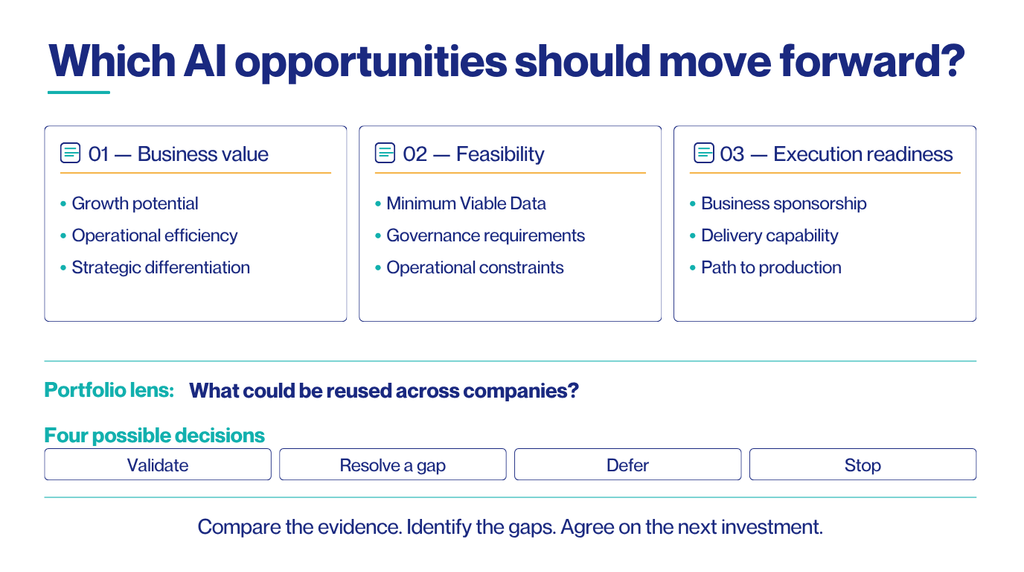
A disciplined prioritization framework helps operating teams identify opportunities with the strongest combination of measurable business value, feasibility and ability to execute. Assess each opportunity against consistent criteria, make the evidence gaps visible and agree on the next investment decision.
How should PE operating teams prioritize AI opportunities?
PE operating teams should prioritize AI opportunities by evaluating three factors: measurable business value, feasibility, and execution readiness.
Start with a specific business workflow and intended outcome. Assess the potential impact on growth, operational efficiency, or strategic differentiation, then evaluate the Minimum Viable Data, governance requirements, business ownership, and path to production.
Each opportunity should lead to a clear decision: advance to validation, resolve a specific gap, defer, or stop. Potential reuse across portfolio companies should be evaluated separately, rather than assumed.
Start with comparable business problems
Before ranking ideas, describe each in the same way. Identify the company, affected workflow, business owner, and intended outcome. Record the current baseline, who experiences the problem, and why it matters now. Then define a focused use case that can test the proposed improvement.
For example, “AI for sales” is too broad to assess. “Help account managers prepare renewal offers using approved pricing guidance” gives teams a workflow to examine. They can then set a target for preparation time or review quality. It also creates an opportunity to ask whether AI is necessary or whether a process change or existing automation would address the problem.
Keep the initial scope bounded. A company-wide ambition can remain strategically important while its first use case is narrow enough to evaluate.
Assess business value and execution readiness separately
Use consistent dimensions across opportunities, but record the evidence behind each judgment. Distinguish observed facts from estimates and unresolved assumptions.
| Dimension | What to establish |
|---|---|
| Growth potential | Which revenue driver could improve, its baseline, and how the proposed workflow change could affect it. |
| Operational-efficiency impact | Which work, delay, or cost could change after review, exceptions, and support are included. |
| Strategic differentiation | Whether the opportunity strengthens a distinctive capability, customer experience, or commercial model. |
| Business sponsorship | Who owns the outcome and can commit funding, people, and operational change. |
| Data feasibility | Which Minimum Viable Data is needed, its quality, access conditions, and accountable owners. |
| Governance and operational constraints | What actions AI may support, required controls, human decision rights, and how errors or exceptions must be handled. |
| Path to production | Required integrations, release criteria, delivery capacity, ongoing support, and adoption work. |
| Potential reuse | Which patterns, assets, or lessons could apply elsewhere, and what adaptation would be needed. |
Growth, efficiency and differentiation do not need equal weight. A company protecting renewals may prioritize a different outcome from one trying to remove a production bottleneck. Agree the priorities before comparing proposals, and avoid counting the same benefit twice under different labels.
Keep projected value separate from confidence in achieving it. Time saved is not automatically a cash saving; faster proposal preparation is not proof of higher sales. Record how the workflow improvement would translate into the business outcome and what evidence is still needed.
Check whether the company can execute
Business sponsorship means having an owner with authority to commit resources and change the workflow, supported by a technology sponsor who can assess delivery requirements. Minimum Viable Data is the smallest set of trusted, well-defined data the use case needs. Assess that requirement rather than waiting for a perfect enterprise-wide data foundation.
Distinguish a manageable gap from a blocking condition. Missing data definitions may require preparation; restrictions on using essential records may change the opportunity entirely. Assign responsibility for resolving each material gap and assess its effect on cost, timing, and the business case before funding validation. A high potential benefit cannot compensate for a dependency the team has no credible way to resolve.
A five-step process for prioritizing AI opportunities
- Define the business outcome. Identify the company, workflow, business owner, current baseline, and measurable improvement expected.
- Estimate the value. Evaluate potential growth, efficiency or strategic differentiation, documenting the evidence and assumptions behind each estimate.
- Assess execution readiness. Confirm business sponsorship, Minimum Viable Data, governance requirements, delivery capacity and path to production.
- Identify gaps and reuse potential. Separate manageable gaps from blocking conditions. Evaluate which use-case patterns could transfer to other portfolio companies and what adaptation would be required.
- Make the next investment decision. Advance to validation, assign an owner to resolve a gap, defer until conditions improve or stop if the evidence does not justify further investment.
Use reuse potential to strengthen the case
Reuse potential can strengthen an opportunity’s investment case when another portfolio company has a comparable business need. Identify the patterns or assets that could transfer and estimate the adaptation required before assigning additional portfolio value.
Assess that potential separately from the first company’s business case. A company-specific opportunity may deserve priority when its expected outcome and execution readiness are stronger. Avoid multiplying an unproven benefit estimate by the number of companies in the portfolio.
Turn the assessment into decisions
Use the assessment to decide what happens next. If ratings are used, agree on their meaning and weighting before comparing opportunities. Review the supporting evidence and unresolved dependencies alongside the result.
Place each opportunity into a decision category:
- Advance to validation: The outcome matters, ownership is established, and feasibility is sufficiently understood to fund a bounded test.
- Resolve a specific gap: The opportunity is credible, but a named uncertainty needs investigation before validation. Assign an owner and review date.
- Defer: The use case may be valuable, but prerequisites, capacity, or business timing make it a later priority. State what would trigger reconsideration.
- Stop or choose another approach: The evidence does not support further AI investment, or a simpler intervention is more appropriate.
Allocate effort across the shortlist realistically. Several promising use cases may depend on the same data specialists, business reviewers or integration team. Sequence work around those constraints and the timeframe in which each business needs results.
What this looks like in a portfolio review
Consider two hypothetical opportunities across a PE portfolio. A pricing recommendation use case could offer substantial growth potential, but lacks a confirmed business owner and access to the required transaction data. A finance exception-handling use case has a smaller estimated benefit, but an engaged owner, an established baseline, and sufficient data to begin validation.
| Assessment | Pricing recommendations | Finance exception handling |
|---|---|---|
| Potential value | High | Medium |
| Business ownership | Not confirmed | Confirmed |
| Data feasibility | Unresolved | Sufficient for validation |
| Path to production | Unclear | Initial requirements understood |
| Recommended decision | Resolve gaps | Advance to validation |
The finance use case may be the better first investment, provided its expected value justifies the effort. The pricing opportunity remains relevant, but requires additional preparation before validation.
The objective is not to prioritize efficiency over growth. It is to invest first where business value and execution readiness are sufficiently supported by evidence.
From AI prioritization to measurable portfolio value
Prioritization is only useful when it leads to execution. Once the highest-value opportunities have been identified, PE operating teams need a repeatable way to validate them, address execution gaps, and move successful use cases toward production.
Calibo helps private equity firms and their portfolio companies apply a structured Business Innovation Methodology to identify, prioritize, and execute focused business opportunities. Combining business engagement and ownership, Minimum Viable Data, governed validation through the Business Innovation Sandbox, and a path to production, the approach connects prioritization with practical execution.
A Portfolio AI Value Opportunity Assessment can provide a starting point for this discussion. Working with the PE operating team and relevant portfolio-company stakeholders, the objective is to identify a practical shortlist, determine which opportunities are ready for validation, and establish the next actions and owners.
The result is not simply a ranked list of AI ideas, but a clearer path toward measurable business outcomes.
Discuss portfolio AI opportunities
FAQs
How can private equity firms identify AI use cases across portfolio companies?
Start with business priorities at each company, including revenue growth, margin improvement, operational efficiency, and strategic differentiation. Identify specific workflows where AI could support a measurable improvement, then assess business ownership, data availability, and execution feasibility. Use consistent criteria to compare opportunities across the portfolio.
Should PE operating teams prioritize growth or operational efficiency?
Neither should automatically take priority. The decision depends on the value-creation plan, business urgency, expected impact, and readiness to execute. A smaller operational-efficiency opportunity with clear ownership and available data may be a better first investment than a larger growth opportunity with unresolved dependencies.
What makes an AI use case ready for production?
A use case needs evidence that it can deliver the intended business outcome, alongside trusted data, appropriate governance, technical feasibility, operational ownership, and a realistic adoption and support plan. A successful pilot alone does not establish production readiness.
Can AI use cases be reused across different portfolio companies?
Yes, some use-case patterns, methodologies, and technical assets may be reusable. However, each company has different processes, data, systems, and governance requirements. Assess reuse potential separately and validate the adaptations needed before assuming portfolio-wide value.
Trending articles

Data orchestration: why modern enterprises need a data orchestration platform
Data is pouring in from myriad sources—cloud applications, IoT sensors, customer interactions, legacy databases—yet without proper coordination, much of it remains untapped potential. This is where data orchestration comes in.

How Enterprise Architects can get more support for technology led innovation
Enterprise Architects are increasingly vital as guides for technology-led innovation, but they often struggle with obstacles like siloed teams, misaligned priorities, outdated governance, and unclear strategic value. The blog outlines six core challenges—stakeholder engagement, tool selection, IT-business integration, security compliance, operational balance, and sustaining innovation—and offers a proactive roadmap: embrace a “fail fast, learn fast” mindset; align product roadmaps with enterprise architecture; build shared, modular platforms; and adopt agile governance supported by orchestration tooling.

Why combine an Internal Developer Portal and a Data Fabric Studio?
Discover how to combine Internal Developer Portal and Data Fabric for enhanced efficiency in software development and data engineering.

The differences between data mesh vs data fabric
Explore the differences of data mesh data fabric and discover how these concepts shape the evolving tech landscape.