
Key takeaways
- AI Career Launchpad 2026 brought together more than 1,000 students, parents, faculty members, and industry leaders at KL University.
- The event focused on practical data and AI career readiness, not just awareness of AI tools.
- Twenty-four students from the first cohort received the Calibo offer letters with 10+ LPA offers, while five students received one-year paid internship letters; admissions also opened for the July 2026 Calibo AI Academy batch.
The Calibo AI Academy AI Career Launchpad 2026 was not just an event. It was a clear reminder that students are no longer asking whether data and AI matter. They are asking how quickly they can become ready for the opportunities ahead.
On May 26, 2026, the main auditorium at KL University, Guntur, was filled with students, parents, faculty members, and aspiring AI professionals. With more than 1,000 people in attendance, the energy in the room reflected more than curiosity. It reflected ambition, urgency, and a shared desire to understand how students can move from college learning to meaningful enterprise careers.
The event brought together KL University and the Calibo AI Academy for a day focused on data and AI career readiness, industry expectations, and practical pathways for students. What could have been a conventional career guidance session became something more personal and powerful: a moment where students could see a real connection between learning, preparation, and opportunity.
The program brought together a distinguished group of professionals, including:
- Dr. Gottumukkala Pardhasaradhi Varma, Vice Chancellor, KL University
- Dr. A. Srinath, Dean, Skill Development and Students Progression, KL University
- Aurobindo Sahoo, Head, Calibo AI Academy
- Chandan Kumar, COO and CFO, Vattikuti Ventures
- Badri Ramakrishnan, Chief Industry Practitioner, AI Academy
- Debasis Ghosal, Head, Human Resources, Calibo
- Vipul Valamjee, Advisor, Government Liaisons and Strategy, Calibo
A practical conversation about career readiness
Across the sessions, the message from the stage was clear:
Data and AI are reshaping industries faster than many students realize, and employability is no longer defined by certificates alone.
Dr. Gottumukkala Pardhasaradhi Varma, Vice Chancellor of KL University, commended the Calibo AI Academy for empowering students with industry-relevant skills that can create lifelong career opportunities. He highlighted the transformative impact of AI technologies such as ChatGPT, Gemini, LLMs, and agentic AI, and encouraged students to prepare for a future where AI will drive innovation, business growth, and employment opportunities across industries.
Students need to move beyond consuming tools and start building the ability to solve real-world problems. Enterprise-readiness requires practical exposure, business understanding, structured thinking, and the confidence to apply data and AI in meaningful ways.
The keynote speakers, including Dr. Gottumukkala Pardhasaradhi Varma, Dr. Srinath, and Badri Ramakrishnan, spoke to the changing expectations of the job market. They addressed the questions many students and parents are asking today:
- What will AI careers look like?
- What are employers really looking for?
- Will AI create new opportunities or reduce traditional entry-level roles?
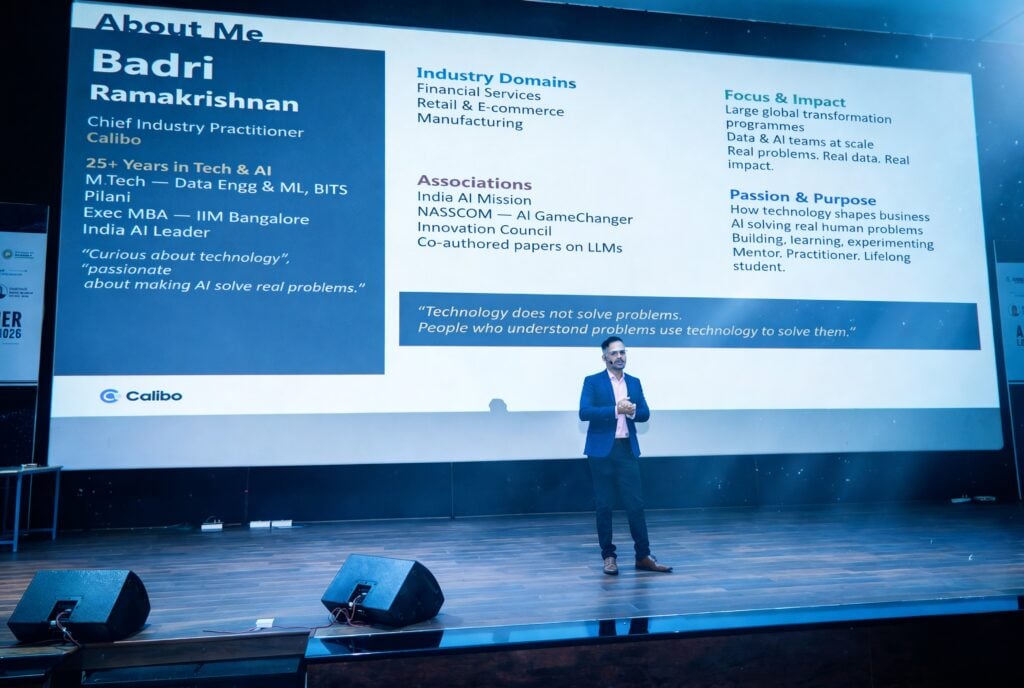
One of the most engaging sessions of the day was delivered by Badri Ramakrishnan. He challenged students to think beyond coding, certifications, and AI tools. Through live audience interactions, thought-provoking questions, and practical demonstrations, he encouraged students to focus on something even more valuable: understanding real-world problems and learning how data and AI can be applied to solve them.
The session sparked active participation from the audience and reinforced a message that echoed throughout the event: technology is important, but the ability to apply it meaningfully is what creates career opportunities.
A vision for the next generation of AI talent
In one of the keynote sessions, Aurobindo Sahoo, Head of the Calibo AI Academy, challenged students to think differently about what it means to prepare for an AI-driven future. Rather than focusing solely on AI tools or certifications, he emphasized the growing need for enterprise-ready professionals who can combine technical skills with problem-solving, business understanding, and practical application.
He highlighted the widening gap between traditional academic learning and industry expectations, noting that organizations are increasingly looking for individuals who can apply AI to solve real-world challenges rather than simply understand the technology in theory.
A recurring theme throughout the session was simple but powerful: the future belongs not to those who merely learn AI, but to those who learn to build with it.
A milestone moment for the first cohort
The emotional centerpiece of the day came when twenty-four students from the first cohort received offer letters from Calibo. These students were recognized with 10+ LPA offers, and the moment carried a sense of pride. In addition, five students received one-year paid internship letters with a stipend of 25k per month, adding another important milestone to the cohort’s achievements.
As students walked up to receive their offer letters, the auditorium responded with applause. Families captured photos and videos. Faculty members looked on with pride. For many parents, it was a moment of reassurance: their children’s hard work, preparation, and commitment had translated into a visible career milestone.
The pride in the room was not limited to the students receiving offers. Parents engaged actively with organizers and the Calibo AI Academy team throughout the day. They asked thoughtful questions about the program, career preparation, industry expectations, and what it takes for students to succeed in a data and AI-driven job market. Their involvement showed how important this conversation has become for families dreaming about their children’s futures.
Strong interest in the next batch
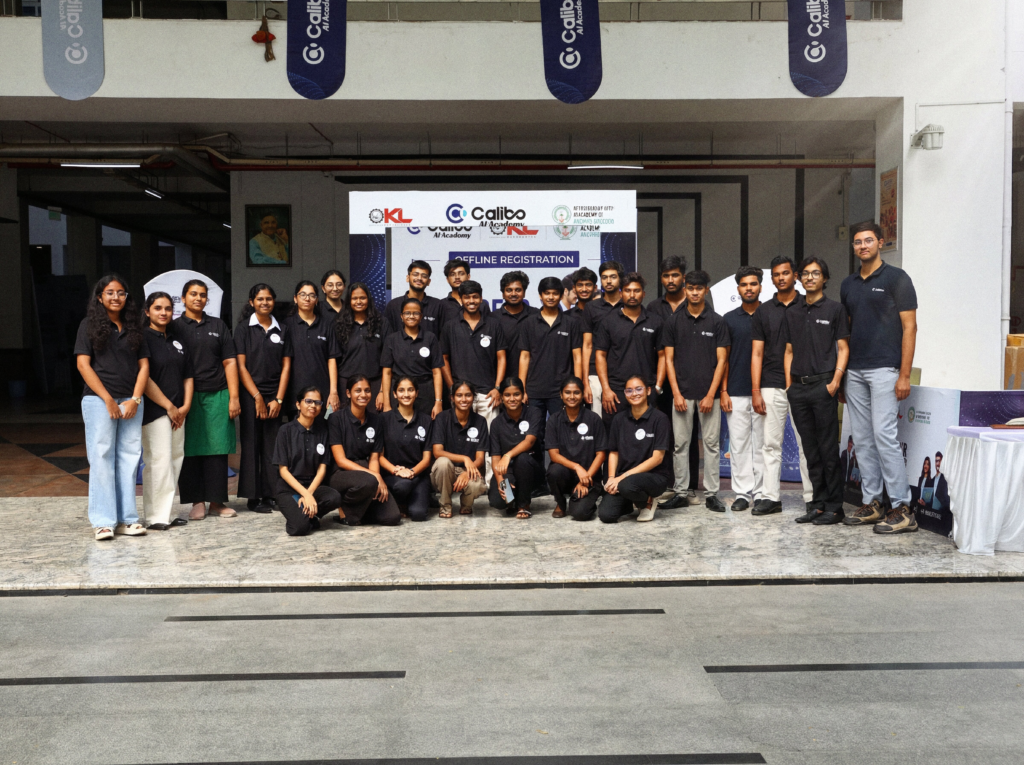
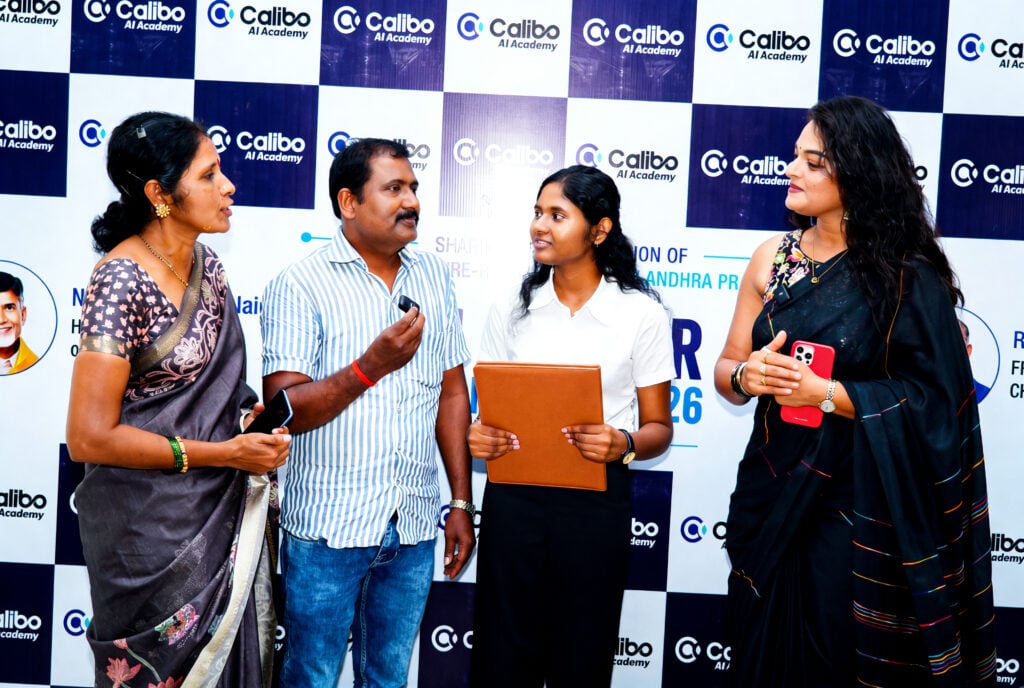
Outside the auditorium, another story was unfolding. The registration and information counters remained busy throughout the day as admissions opened for the Calibo AI Academy, July 2026 batch. Students gathered around the booth to ask questions. Parents joined the discussions to better understand the commitment, learning model, and career relevance of the AI Academy.
What started as curiosity quickly became deeper conversations about preparation, discipline, and the need for practical exposure. Many students arrived wanting to explore AI careers. By the end of the event, many were thinking more seriously about the next step.
A shared sense of possibility
AI Career Launchpad 2026 ended with gratitude and optimism. The Calibo AI Academy extends its thanks to the students, parents, KL University leadership, faculty members, speakers, organizers, Red Chariots, volunteers, and support staff who helped bring the event to life.
The day was all about possibility. It brought together students eager to learn, parents eager to support, educators eager to guide, and industry leaders eager to share. The packed auditorium, thoughtful questions, proud smiles during offer-letter distribution, and strong response at the registration booth all pointed to one thing: students who are serious about building meaningful data and AI careers are actively seeking opportunities that help them prepare for the future.
And on May 26, that future felt a little closer.
The next batch of the Calibo AI Academy starts soon. Apply now!
FAQs
What was the highlight of the AI Career Launchpad 2026 event?
The key highlight of the event was the offer-letter distribution, where twenty-four students from the first cohort received offer letters from Calibo with 10+ LPA offers. Admissions also opened for the Calibo AI Academy July 2026 batch at the registration booth during the event.
How was AI Career Launchpad 2026 different from a regular career guidance session?
AI Career Launchpad 2026 went beyond a typical awareness session because it connected student ambition with real career preparation. The discussions focused not only on data and AI opportunities, but also on what students need to become enterprise-ready: practical problem-solving, hands-on exposure, business understanding, and the ability to apply learning to real-world use cases.
What message did the event leave for students interested in data and AI careers?
The event reinforced that interest in data and AI is only the starting point. To build meaningful careers, students need structured preparation, industry mentorship, and opportunities to work on real-world business problems. The strong response from students and parents showed that many are now looking for learning pathways that connect classroom knowledge with practical career readiness.
Trending articles

Data orchestration: why modern enterprises need a data orchestration platform
Data is pouring in from myriad sources—cloud applications, IoT sensors, customer interactions, legacy databases—yet without proper coordination, much of it remains untapped potential. This is where data orchestration comes in.

How Enterprise Architects can get more support for technology led innovation
Enterprise Architects are increasingly vital as guides for technology-led innovation, but they often struggle with obstacles like siloed teams, misaligned priorities, outdated governance, and unclear strategic value. The blog outlines six core challenges—stakeholder engagement, tool selection, IT-business integration, security compliance, operational balance, and sustaining innovation—and offers a proactive roadmap: embrace a “fail fast, learn fast” mindset; align product roadmaps with enterprise architecture; build shared, modular platforms; and adopt agile governance supported by orchestration tooling.

Why combine an Internal Developer Portal and a Data Fabric Studio?
Discover how to combine Internal Developer Portal and Data Fabric for enhanced efficiency in software development and data engineering.

The differences between data mesh vs data fabric
Explore the differences of data mesh data fabric and discover how these concepts shape the evolving tech landscape.